Showing posts with label Ursula K LeGuin. Show all posts

13 February 2019

Palliative Reading: Zen Comics and Ursula K LeGuin's Tao Te Ching

3579
These are all times of extreme dexterity and chaos for many of us, and just because one has learnt to live with chaos doesn't mean that chaos is welcome.

And that's as may be. Comes the time, more than often, when what one sees bearing down on one becomes intimidating and the ability to stay on an even keel leaves of its own accord. You can't knowingly coax it back, but you can recreate it.

Recently I had trouble sleeping, freight train running in my head and all that, and The Wife™suggested I read some paper book. Not book on my cheapo yet faithful tablet, that involves that blue-biased backlight which doesn't really do your biological system any good, really kind of destabilizes it, and paper book reading is a very somatically satisfying thing to do, as one can find out for ones self by just doing it (hell, I just feel better holding a book in my had, but that's for another time). And my The Wife™, she know me well, and suggested.

There is a pair of delightful little volumes called Zen Comics (not to be confused with the webcomic Zen Pencils). This modest collection of panels was drawn by a Buddhist named Ioanna Salajan, who was part of a Zen Buddhist community in Amsterdam back around the early 1970s, and they had a periodical called Cosmic Paper. She did these for that publication. What they are are little 4-panel (mostly; some of them break that to illustrate a joke or a theme) situations based on, as I understand it, Zen concepts or koans (and a koan, as I understand it, is a riddle or question that has no sensical answer, the point of which is to embrace the absurdity and acquire understanding from the point of view that provides).

There are around 100 of them in all split between two rather small volumes, titled Zen Comics and Zen Comics II. They are all charming little things that you glance over, then glance over again, and then move on and come back to. At first it's the comic style seeming to combine brushwork and fine line; the whole artistic style, seeming at once unashamedly primitive and childlike but somehow simultaneously sophisticated; and the feeling that it's all trying to communicate with you on a visible and and invisible level.

The comic has a handful of characters. The star, though I don't know if he'd say so, is The Old Monk, that chap on the cover graphic in the robe and that stylish beard with the head with the high dome. The co-star, who I've heard referred to as Number One Disciple, is his most frequent foil (and target of his switch) and serves as a relatable interlocutor. There's also Rinzo, a burr-headed chap who would be a Number One Disciple someday, if only he could figure some basics out. There are some other Zen practicioners, a few Western tourists, and one Samurai warrior who has an epiphany.

There's a whimsy that makes it all approachable even if the point is frequently ineffable (something I also understand a good koan's lesson should be). And I don't know if I'm getting the point of it all, but reading it (as I have many times, it never gets old) again and again always makes me feel a kind, gentle humor within.

It's been reprinted many times; my 2-volume set was printed by Charles H. Tuttle publishers back in the 80s. It's a pleasant reprieve for the weary mind. I recommend it to you.

The other book I've been absorbing is Ursula K. LeGuin's rendition (as she says herself, it's a rendition, not a translation) of the Tao Te Ching. It's a pleasant looking book, small, square, containing two CDs of her reading it as music plays in the background. I've not listened to the CDs yet. I read it, like Zen Comics, frankly, not quite comprehending what I'm reading but it's speaking to me on some level. I love it because UKL did it, of course, but there is a comfort to reading these poems not yet knowing what they are totally supposed to say but feeling their truths falling into place in some internal way.

Ursula K LeGuin's affection for the work makes it a soft, kind thing, and it too, helps me calm the anxiety.

And so it goes.

15 June 2018

Busking With Strings, SW Broadway And Main, Portland

3540A.
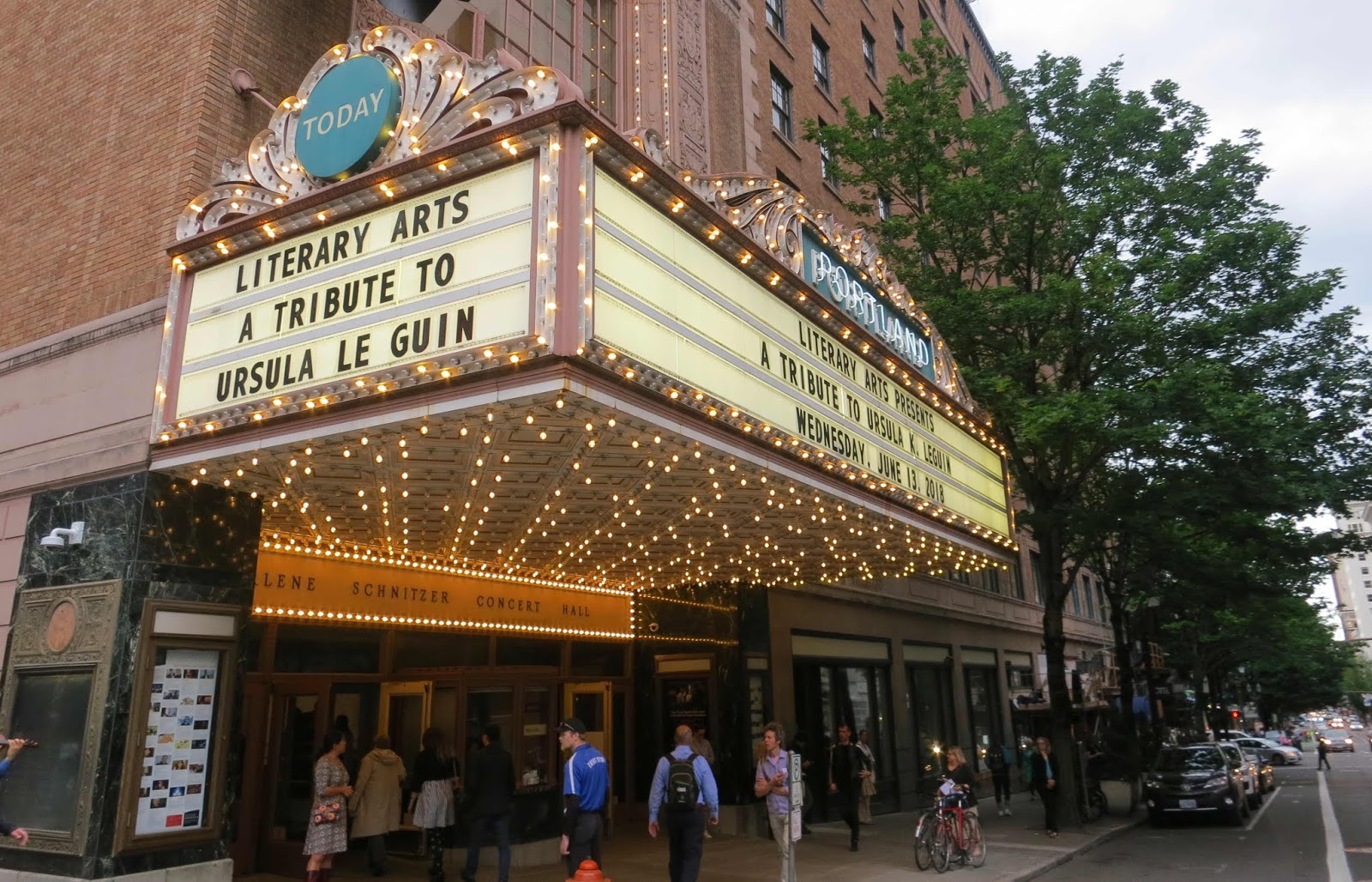
Yesterday night, before the Ekumenical meeting, on the way into The Schnitz, we saw this fellow.

As appropriate for the dignity of the surrounding venues, he played adept classical violin.


He was quite adept and pleasant to listen to. Sadly, we didn't have any cash to tip. Hopefully sharing him on a blog will suffice.

He really was delightful, and in just the right place: SW Broadway and Main, in front of Oregon's finest performance space.

He is Tomoki the Violinist, in case the photo isn't of sufficient rez to peep his business card in his case there. There's a Twitter and and Instagram feed there too, I see.


14 June 2018

The Ekumen Convene: Portland And The World Celebrate Urusla K. LeGuin

3539A.
On Wednesday, 13 June 2018, here in Portland, the city she called her own, a group of people devoted to her writing and her life of art convened to celebrate the legacy, still present in our minds and breasts, of Ursula Kroeber LeGuin.

We started out in order to get there at a propitous time and found a parking spot scarcely a block away from the venue, The Schnitz, and within view of the back door of the theatre. As far as omens go, which I don't believe in, this was a good one, so maybe there's something to that.

My life typically does not extend the opportunity for venturing out into such a place. I've lived in Portland for a very long time now, and I tell you truthfully that I have not had the chance to step into the legendary Arlene Schnitzer Concert Hall. It was a happy thing that Literary Arts made this a free event and that I was able to score two admissions to it.

We wuz there.

The evening was a two hour program which interleaved visual media featuring Ursula and brief monologues by artist who had worked with her, been inspired by her, called her friend. It is now a truth that I can say that for a brief, brilliant time I shared a room with China Miéville, Jonathan Lethem, and Portland City Commissioner Chloe Eudaly, all of whom I'm fans of.

Follows a retrospective impression, strained through a cronically faulty memory:

The speakers whom I'd not as of yet heard of, for a variety of reasons, spoke warmly and deeply and affectionately of her. The writer Molly Gloss spoke of an adventure in friendship beginning as a writer's workshop. Walidah Imarisha spoke of the debt visionary fiction has to Ursula and the disappointment (and dissent from Ursula) when the TV version of Earthsea gave us a Ged who was white ... not red-brown, as per the text. Kelly Link told of her experience editing and publishing Ursula for her small press and how her daughter got to be her namesake, and brought the house down with an anecdote where Ursula compared a pissed-off bantam rooser with a Fox News Republican. Daniel José Older spoke with much wit and sass about how Ursula invited us to make peace with, not repudiate, our own dark side, to make ourselves whole. Julie Phillips, Ursula's biography, spoke of her sharp and dry wit. Andrea Shulz, her editor at Harcourt, told of the role she had in brining Ursula's last novel, Lavinia, to print.

Margaret Atwood was there in recorded form, hailing us from the distant planet of Canada. Seems more distant every day.

The stars for me were, of course, Jonathan Lethem, author of Gun, With Occiasional Music, a book I loved, and he spoke of Ursula's power to be a bridge between here and there, between genre and mainstream, between people who didn't necessarily live on the same page; and China Miéville let us all in on a little secret; the incarnation of darkness that Ged released in Earthsea was inspired by the ... of all things ... tardigrade.

Yeah. That cute little nigh-indestructible water bear.

You learn things.


The above photo was taken during the intermission. I didn't snap any photos during the event (that's just rude, and they asked us not to) and on the screen, during the lull and before the event, were a succession of quotations and book covers over the career. I made sure to snap on that included The Lathe of Heaven, and that's what you see above.

The evening ended, after China's monologue, with the quote about how those who deny the existence of dragons are frequently eaten by dragons, which served as the cue for the entry of a troupe of dragon dancers, which will exist in my memory as a happy thing.

Some of my Ekumenical compatriots produced recording devices and used them. Gentle shame on you folks.

The dragon danced its way back out the door and a message on the screen invited us to follow it out to Main Street. I stopped on the way to sign a board where a number of us fans signed, and I paused for a minute, and then something that had apparently been forming for a long time in me catalystically gelled and compelled itself through my arm into the Sharpie pen:


The Lathe of Heaven is my Bible, and George Orr is my savior.

And so a gathering of the Ekumen, with a full house at the Arlene Schnitzer Concert Hall in Portland, Oregon, my town, Ursula's town, town of dreams that if you push hard enough you might change at will (though sometimes that pushing seems of Sisyphean proportion), along with thousands who came in by ansible from locations scattered across the continent and perhaps across the globe, went our separate ways into the night.

We all take a little bit of Urusla with us, of course, in our own ways, in our own minds and hearts.

03 May 2016

[pdx] A Review of UKL's The Lathe Of Heaven 45 Years In The Making

3321.
One of the more interesting sorts of literary critiques is from those who come to the work late.

The Lathe of Heaven is Ursula K. LeGuin's 1971 masterpiece, a subtext-laden love letter to Oregon and the nature of existence and human affection and love, and the most Portland novel ever written. It clothes its story so well in its setting ... A now-alternate-past version of Portland and northwestern Oregon ... that it's hard to believe that LeGuin wasn't a native Oregonian. It's the novel that caused me to fall in love with her writing, and the way she looks at the world.

At the blog Biblioklept, posted last October, review Edwin Turner posts an intriguing and accessible interpretation of his experience reading the novel for the first time, making a solid case that it's Heather Lelache, not George Orr or Dr. Haber who is the pivotal character of the story. He ends his review thus:
The Lathe of Heaven is a propulsive and intriguing read. I can’t believe I hadn’t read it before now. Great stuff.
To which we say, better late than never.

Read the review at https://biblioklept.org/2015/10/28/a-review-of-ursula-k-le-guins-novel-the-lathe-of-heaven/. 

22 April 2014

[pdx] Photos on Sunday: Tilikum and Terrior, Via Ursula K. LeGuin.

3066.
If there are discussions about what is the quintessential Portland novel, and, more over, a novel is sine qua non as far as a "Portland literature" is, it would be Ursula K. LeGuin's The Lathe of Heaven.

A bit of an introduction if one has not been. The Lathe of Heaven is set in a fictionalized Portland and Oregon of the year 2002 (it now qualifies as an alternative history). It concerns George Orr, a man whose dreams can literally alter reality, and Dr. William Haber, a sleep and dream researcher … an onierologist … who discovers the quality of this power and tries to use it to recreate the world in a better version … sans war, sans hunger. Each dream is incarnated in unpredictable ways, causing eventual chaos, a kaleidoscope world and, unwittingly, revealing Dr. Haber as a megalomaniac, if a tender, loving one.

The novel got its hooks into me (and has permanently done so … laying next to this computer at this time is a paperback copy I got at Powell's on Sunday evening for $2.95, making this possibly the most Portland thing I could physically accomplish) with its fictionalized vision of Portland of the year 2002. Writing in the late 60s and early 70s as she did, I presumably assume that at least a part of her found it somewhat inevitable that Portland might expand, toxically, and ruin its own character.

The Portland at the beginning of Lathe massed 3,000,000 … as many people as are in the whole of Oregon today, less about 800,000 … and the New Cities of the then not-so-dry Oregon Outback had populations of approaching 7 million each. 


The Portland portrayed in the novel had a few geographical inconsistencies, but none worth noticing overmuch. Something about the narrative … the easy way she wrote of local geography, the familiar timbre to the words … made it plain to me that she knew this area intimately. She had a sense-of-place. The writing had a particular terrior… it simply couldn't have been written by anyone else, or anywhere else.

It was Oregon, fictionalized by an Oregonian, who loved Oregon. It felt good to read, and still does, to this day. I read Lathe to wallow in the descriptions of Portland, the free and casual way words like Willamette, Linnton, Zigzag and Rhodoendron are used. And if a few details are off … mentioning a place as 209 SW Burnside St … then the tender loving care with the place that is otherwise taken more than makes up for that.

Of course, the story is about a man whose dreams change the nature of reality. There's probably a little editing going on there as well.

Wandering up and down the Eastbank Esplanade, near OMSI, to get a good look at the Tilikum Crossing, the Bridge of the People. Not for the first time, looking along the river where, at many angles, you can at once take in automobile bridges and an aerial tram but also, now a bridge for trains, bikes and people only, did a feeling grasp me … and then I had it.

Passages from The Lathe of Heaven, meditations on getting around in the overpopulated, overpolluted, overmoist Portland of the fictional year 2002 invaded my consciousness and did not let go. I had to get a copy of the book to read again, you see. I had no choice.


We join George Orr as he travels from Vancouver to Portland on a subway (can you imagine?):
To go under a river: there's a strange thing to do, a really weird idea.

To cross a river, ford it, wade it, swim it, use boat, ferry, bridge, airplane, to go upriver, to go downriver in the ceaseless renewal and beginning of current: all that makes sense. But in going under a river, something is involved which is, in the central meaning of the word, perverse. There are roads in the mind and outside it the mere elaborateness of which shows plainly that, to have got into this, a wrong turning must have been taken way back.
 There were nine train and truck tunnels under the Willamette, sixteen bridges across it, and concrete banks along it for twenty-seven miles. Flood control on both it and its great confluent the Columbia, a few miles downstream from central Portland, was so highly developed that neither river could rise more than five inches even after the most prolonged torrential rains. 
 The Willamette was a useful element of the environment, like a very large, docile draft animal harnessed with straps, chains, shafts, saddles, bits, girths, hobbles. If it hadn't been useful, of course, it would have been concreted over, like the hundreds of little creeks and streams that ran in darkness down from the hills of the city under the streets and buildings.
 But without it, Portland wouldn't have been a port; the ships, the long strings of barges, the big rafts of lumber still came up and down it. So the trucks and the trains and the few private cars had to go over the river or under it. 
 Above the heads of those now riding the GPRT train in the Broadway Tunnel were tons of rock and gravel, tons of water running, the piles of wharves and the keels of ocean-going ships, the huge concrete supports of elevated freeway bridges and approaches, a convoy of steamer trunks laden with frozen battery-produced chickens, one jet plane at 34,000 feet, the stars at 4.3+ light years.

Later, very near the end of the book, Orr travels across a Portland that was, in some ways, a crazy quilt of all the possible Portlands that he had, at one time, dreamed:
Orr returned to downtown Portland by boat. Transportation was still rather confused; pieces, remnants, and commencements of about six different public transportation systems cluttered up the city. Reed College had a subway station, but no subway; the funicular to Washington Park ended at the entrance to a tunnel which went halfway under the Willamette and then stopped. Meanwhile, enterprising fellow had refitted a couple of boasts that used to run tours up and down the Willamette and Columbia, and was using them as ferries on regular runs between Linnton, Vancouver, Portland, and Oregon City. It made a pleasant trip.

Weaving UKL's words (with due apologies) amongst the pictures creates a trip of its own. SF doesn't predict, it guesses and wonders; we should not be surprised that TriMet didn't take on LeGuin as a long-range planning consultant (though I figure it would be better off if it had). Still, contrasting the dystopian future of Portland in prose with the significantly cheerier (if still flawed) present, it's hard not to see the resonance. They regard each other as brothers by different mothers. They, oddly, mesh … the one being the flip side of the other.

In an ineffable way, the terrior that made Lathe possible wells up, unseen. The book beatifies and explores its setting without wallowing in it, by dwelling on what is, and the voice you hear whispering the details is the real-world surroundings … at least, those in the year it was written.

The quintessential Portland novel. There can be none other.