Showing posts with label Iconic Portland. Show all posts

01 July 2024

An Icon in A City That's Made Of Icons

4155It's the sign on the White Stag Block. We all know about this one.


Began life as the sign for White Stag Sportswear; became Made in Oregon for a while, and then the University of Oregon wanted to place their name up there.

That didn't go over well. The Ducks are popular here, but not that popular.

At that point the Portland City Council stepped in, led by Randy Leonard, buying the sign and making it an official symbol of the city. It's said Portland Oregon ever since. 

The tradition of the red-nose on the leaping stag has maintained. Ploosa shaunge.

26 May 2024

The Multnomah County Fair, 2024

4141We went to the fair on Saturday, which is a very very Memorial Day Weekend thing to do. But it was in Oregon's smallest and most urbanized county, that being Multnomah, which means it's not the same County Fair energy as, say, Clackamas, or Benton, or Marion, et al. 

It's not even like Lane, where the second, no, third, no, second, no, third-largest city in Oregon is located. The Multnomah County Fair is more than a century old, but as city covered what arable land Multnomah County had, and public money being what it usually is, the nature of the fair has changed.


The event is a small, friendly doing alongside Oaks Amusement Park, which provides a ready-made carnival midway. It's extremely budget-friendly, being free, except for parking your car, which is an extremely-reasonable fiver for the whole day you're there.

The fair itself comprises an event stage, a group of vendors along one of the paths from the parking area to the historic dance hall, and a section of small livestock exhibits, typically rabbits and chickens.


The rides of Oaks Park go a long way toward providing the classing County Fair atmosphere. 

The real place this sincere little event shines is in the exhibit hall, and it has that old-school County Fair vibe in full. I have pictures that I'll post in a subsequent entry. The rustic atmosphere of the Oaks Park dance hall go a long way there.

The stage this day had a lineup of local Latinx culture that was full of spirit and verve. Couldn't help but make me smile to look at.

There will be a few more pictures and ruminances next entry.

08 December 2020

The Afterlife Of A Dead Portland Racetrack

3773

This is a thing that exists, now. NE 82nd and Killingsworth. This is a building that's been many things over the years: restaurant, bar, strip joint. The name that comes to mind is Taylor's Viewpoint. But haute cuisine? No.

Here's what it is now:


It's the remains of Portland Meadows, or at least, that's the way it's branded. And there's a lingerie espresso kiosk in the parking lot, which does not seem wholly inappropriate.

The actual horse racing track, the one that stood for more than 50 years just off I-5 near Delta Park, is gone now. It was demolished in February, but had by then largely moved on from horse racing ... a sport, outside of its marquee events, that appears to be trending toward irrelevancy across the United States. But Portland Meadows did do a steady business in off-track betting and poker tables, and that's what we have out here at 8102 NE Killingsworth which is, withal, the sort of intersection you'll be going through for one of only a handful of purposes, all of them adult. 


So it goes.

10 August 2020

The Giant Jug On Sandy Blvd

3728

There's a dive bar of incredibly long staning along Sandy in Northeast Portland. 

On the north side of Sandy, on another one of those flatiron blocks, this one also bounded on the west by NE 74th Avenue and the north by NE Beech Street, is a building with a long history. Lore I've heard recounts it as having been built in 1928 originally as a tire and auto repair joint. I don't know when it became a dive bar, but that it did for years and years and years. 

It's one of those buildings which became a landmark and probably still exists because it is one. 

I give you The Pirate's Cove:

The Pirate's Cove is a dive bar, and one of Portland's many strip joints; it has been named suchly since 2002, and eighteen years is an eternity in Portland cuisine these days. Before that, though, it was an outfit called ... are you sitting down? ... 

The Sandy Jug.

This terra cotta drabness is just one of many dressing changes for the building; at one time, the spherical cork in the jug was painted like an eight-ball.

That's it: just another Portland dive-bar strip-club ... of which there were a dwindling number going into the pandemic time.

19 April 2020

Out 122nd Way: Tonkin, For The Love Of Vintage Signs

3646
Well, be honest, I've posted Ron Tonkin's sign before. But boy, how I love that edifice.

This is what it looked like today. A tiny little bit of the past proudly defying the march of time.


It's scarcely changed in the five-or-so years it's been up in front of Ron Tonkin's old place.

122nd belonged to the Tonkin family, in a way; Ron's brother Marv had the spot at NE 122nd and Halsey that's Courtesy Ford today; it had a distinctive architecture with roof supports that reminded one of the towers on the Saint Johns Bridge, in a reductionist-abstract sort of way (a photo of that plus stationery showing the design's use as a logo can be seen at this page: http://www.thecoralsnake.com/Tonkin). And it was the Tonkins' coinage in ads that supply the tag for this and commonly-themed posts here as well as how I think of my favorite road: Out 122nd Way, as they said.

Marv Tonkin also gave us a jingle that rings in the heads of Portlanders of A Certain Age (Keep honkin'/For Marv Tonkin/That's Maaarv Ton-kin Ford!) which remains memorable decades after Marv went out of business.

Ron sold Chevies, and Marv sold Fords. I'll bet family gatherings had a certain quality betimes.

But, Ron Tonkin remains and stands proud along 122nd between Burnside and Glisan, where it always was and, through evolution in automobile technology as we move toward the terminal phase of the internal combustion engine, likely always will be; a true Portland cultural artifact, one foot in the present, and one foot solidly in the past.

I'll always have time to snap a picture of this.

13 February 2020

Vanport, And All That Came After

3606
Last evening we saw an oral history presentation at the Midland Library called "A Place Called Home: Vanport to Albina", presented by the Vanport Mosaic project.

It was quite an experience.

I expected an informative Portland history experience, and that's what I got. Got more than that, though, much more. The presentation was well-attended, and a great many in the audience had histories stretching into Vanport ...

Vanport is a thing that can be Googled and read about in books. It was, for a short time, one of Oregon's largest towns. During the years of 1942-1948, it housed literally tens of thousands of people who came to Portland from all over the USA to work in Henry Kaiser's shipyards. What it physically was was a housing development on the floodplain of the Columbia River between the Columbia Slough and the river's south bank and running east from the railroad embankment to Denver Avenue and today's Interstate 5. The footprint of Vanport (so named because it was shimmed between VANcouver and PORTland) is still visible between the river and the slough, the railroad embankment and Denver Avenue; some of the streets of Vanport were evolved into parts of the track at Portland International Raceway.

At the end of May, 1948, the railroad embankment - which was holding back a historically-swollen Columbia River - gave way, letting waves of floodwater rush in. The buildings making up the houses of Vanport - inexpensively constructed, on inadequate foundations - floated about like toy boats in a bathtub. In just a few hours, Vanport became a "Dead Memory of Portland" decades before such a thing became cool. The residents, a large percentage of whom were not white, suddenly found themselves having to sink or swim, socially and economically, in a city that to this day is still renowned for being Caucasian AF. Discrimination and redlining put them in the North Portland neighborhood known as Albina and set the tone for decades of race relations in Portland.

The presentation was one of stories. Stories from those who survived the flood and went on to forge lives in Oregon and Portland. They were personified in the flesh by Velynn Brown, a granddaughter of Vanport survivors and a grandmother now herself; she told the story of community handed down through the generations with warmth, emotion and undeniable passion, family, and basketball rivalry ... the longstanding crosstown struggle between Portland's Jefferson and Grant High Schools being a contest that would stand up in furiosity against any big-league tug-of-war.

The real impact for me was all the living history in the room. There was an elderly Japanese-American couple there; they not only were interred during World War II but landed in Vanport because, as Americans of Japanese descent, it was the only place that they could go. Harvey Garnett put in an unexpected appearance: it was he who owned and operated the only black-owned movie theatre in Portland (and perhaps America), The Alameda, which we know today as the Alberta Rose Theater at NE 30th and Fremont.

In the 1970s, the Williams Avenue commercial district was displaced when the Portland Development Commission's plans to allow Emanuel Hospital to expand throughout that area were executed, a move that destroyed Oregon's black downtown. It's one thing to read about this thing, but it's a palpable thing when all those descendents of Vanporters are watching too. They're seeing their own pasts and it's as though all those people who lived in those times were there with you too, eager to tell their stories to those who would listen.

After the event, oral historian Velynn Brown converses with
Harvey "Mr. Alameda" Garnett


There were just three white men in there, and I was one-third of that. Never fear, White America, one of us White Men bravely and compassionately informed the presenter that it's also important to remember that there were people of other skin colors and while the black experience was important, maybe from here we could all move forward as one. That is to say, he brought nothing; the presenter handled him with respect and graciousness. I just wanted him to stop talking. From this I received the takeaway that while life may offer one numerous opportunities to speak out, it offers us infinitely more opportunities to constructively shut the fuck up.

Velynn Brown and Harvey Garnett


This also taught me another thing. Vanport Mosaic is practicing what they call memory activism, which seems to be the idea that remembering what happened to those who came before us can actively reshape the present.

What I really learnt tonight that was valuable was not only all that I've maundered about but also this: listening to marginalized voices is resistance, and remembering their stories is a political act.

I recommend it to those who wonder what they can do in these times of great dexterity.

The Vanport Mosaic Project's online home is https://www.vanportmosaic.org/.

13 July 2019

Ukulele Player On Woodstock Blvd

3580
On Wednesday last week, My Brown-Eyed Girl was down in the hidden southeast part of Portland, taking the car in for a bit of necessary, and while waiting out that process, spotted this genuine human on SE Woodstock Blvd ...


They were exhoriting us to do our homework naked, and eat our cereal with a fork.

Amanda Palmer music, I understand.

10 July 2018

The Saint Johns Bridge: Coming Back To Town

3554.
Got another snap before we left the parking area on Bridge Avenue: as I said earlier, the west end of the bridge runs right into the hillside. At that end, the roadway makes a T-intersection with Bridge Avenue which allows a good viewpoint for a straight-on view up the road.


The pavement makes it easy to snap this POV without having to walk out into traffic to do it and really puts the gothic arch details of the tower into viewable aspect, letting them be the star.

This corner of Portland is quite far out from the city center, nearly seven miles out. Views south and east from the roadway, both NW Bridge Avenue and NW St Helens Road, reveal the working harbor of Portland, the lowest few miles of the Willamette River - wide, cool, and mighty.

That lift span bridge in the middle distance is Portland's hidden bridge, which doesn't even have a name really, and carries the railroad main line north into the cut through the North Portland peninsula and to Vancouver and points north.

Though the area on the west side of the river does have a rather descriptive name: Willbridge. 
 

NW Saint Helens Road travels between industry and tank farms on the left as you're inbound to city center, and on the right, the towering, forested hills of Forest Park. Old, careworn industrial lots and orphaned gas stations predominate on the right hand side of the road as well, with a handful of homes (including two rather incongruous vintage fourplexes) scattered amongst, and a few avenues intersecting numbered in the NW 60s running back only about a block before dead-ending into the hill.

Very soon on the end of this district, at the cross street of NW Kittridge Avenue, the main road swerves and assumes the name NW Yeon Avenue, Saint Helens Road assuming the role of the old highway and straightlining amongst the industrial district toward the center of town. It's then, more than three miles out, that you notice the great arch of the Fremont Bridge, one of the other iconic river landmarks.

It's somewhat intimidating when you get to the point illustrated here:


... and you're still more than a mile away.

08 July 2018

The Saint Johns Bridge: Framing and Color

3553.
Now that I was finally on-point, it was time to play with framing and the effects thoughtfully provided in-camera to the Canon Powershot S-100 by the manufacturer.

This first one is something of an "expected" compostion, good for just a nice picture you can enjoy and lose yourself in. Landsape.


I've zoomed and cropped to give you a good look at a couple of features of the local geography. Notice the grove of evergreens there at the middle of the left side of the photo? That's a large park on the west side of the St. Johns neighborhood called Pier Park. And, despite the proximity to some of the working Portland harbor, it's not named for a bit of nautical architecture, but a city commissioner, Sylvester Pier, who was Parks Commissioner from 1919 through 1923.


Above the right end of the grove you can just barely see the cone of Luuwit ... Mount St Helens. The predominance of blue light and white cloud makes the volcano kind of soften back into the background. On a truly clear day you can just sew Washington's highest peak, mighty Tahoma ... Mount Rainier.


Just a few feet up the trail from the viewpoint an opening in the foliage provided an additional framing opportunity so I grabbed it. The strong vertical lines of the bridge's towers lent themselves aptly to a portrait orientation.

Still, the photo doesn't do justice to the way the bridge's architecture dominates the visual field. This is something you have to experience in person. Framing and composition, as with Wy'east, only gets you part the way ... a great deal of the way, but there's nothing like the human experience.

And, the next two photos take advantage of the monochrome filters on the camera to produce dramatic images with emotional content for me. I recall seeing similar monochromatic images as station-ID cards on local TV when I was just a runt, so this takes me back to Silverton, when my only idea of what Portland was, was on the TV.

Black and white:


... and an unexpectedly-intriguing blue tone, which works even better in portrait.


The Saint Johns Bridge: The Path Up To The Viewpoint

3552.
The trailhead to the trail to the viewpoint is easy to miss. The stairway to the trail was built aeons ago, in anno urbis Portlandiensis terms, and it blends in amongst the slope and the shade from the trees and the ivy that covers the hillside. This is what it looks like in Google Street View because I was so intent on going up there, that I didn't stop to lens it.

I, like my camera subsequently, was auto-focussed.


It's easy to drive past. The parking area for this, additionally, is about 200 feet (more or less) down the slope (on the left of that view). It's also not much of a parking area: it's more of a wide-spot turnout. Five or six cars and its full.

But it did give me the chance to take a few nifty snaps on the way up. So, there's that.


This steep, narrow, old concrete staircase is the first step. Up, left, up, right, then to a levelled-out spot created of that big retaining wall.

You'd think there'd be something of a view of the bridge from that, but, no; the trees that have grown there over the years completely obscure it. Of course, the view of the trees, as is the knowledge that one is on the edge of Portland's Forest Park, is invigorating in its way.

It also becomes obvious why they call it that ... if it wasn't already.

Herein, the top of those stairs:


The blue-clad lady is actually a forest nymph of whom I'm terribly, terribly fond. Below the railing is the bridge approach. Diverging up and behind her is the trail to the viewpoint.

This, as one can see, is not a 'walking path' or a bike route (well, unless you're insane). This is a trail, in the sense of a path I would encounter back when I was the world's most crap Boy Scout. This an old school trail. And the trail, as can be seen in the next photo, is kind of treacherous in spots; the wifely nymph, who has occaisional problems with vertigo affecting her sure footing elected to stay here and wait on me.


That root and the slope across the trail are ankle-twisters for sure. I could not criticize my wife's reluctance.

But for me, onward ... ever upward. The trail after that is narrow, but passable and steep, but not too steep. My out-of-shape self broke a sweat. But it was a beautiful environment to be in.


The viewpoint comes on you suddenly after less than three minutes of climbing this path. It's a wooden platform with a rail on the downhill side; the ground below it kind of dips into a tiny crevice, only a foot or two deep, giving the impression of a half-bridge. Though small, there's enough room for a modest number of people to view, and while a few people came past me as I was there, I never felt crowded.

And all you have to do there, is turn, and look through the foliage. There it is.


The feeling of depth and space and vista overtakes one immediately. The image above seems to be of looking out through a tunnel in the ground cover. The truth of the spot is it actually feels wide and open, something of a visual megaphone: like the sound version amplifies your voice from a point to spread out via a horn, the outlook seems to be a lens, pulling in more space and distance than a mere photograph can illustrate.

I stood for a number of minutes before I actually snapped any pictures, taking an experiental snapshot, a memory that I should hope never fades.

I then, of course took a number of pictures. More on that next episode.

06 July 2018

The Saint Johns Bridge, Portland, Oregon

3550.
Well, we did it. I braved that trail and got up to the viewpoint and did the thing and now, like every other photographer, amateur or professional, who wants a picture-postcard view of the most beautiful bridge known, I has my own copy.

This is an icon of Portland ... the Saint Johns Bridge


There is a little bit of an experiential story to go with this, and I shall tell it anon. For now, a bit of rest is in order.

But, good heavens is that a pretty bridge!

14 June 2018

The Ekumen Convene: Portland And The World Celebrate Urusla K. LeGuin

3539A.
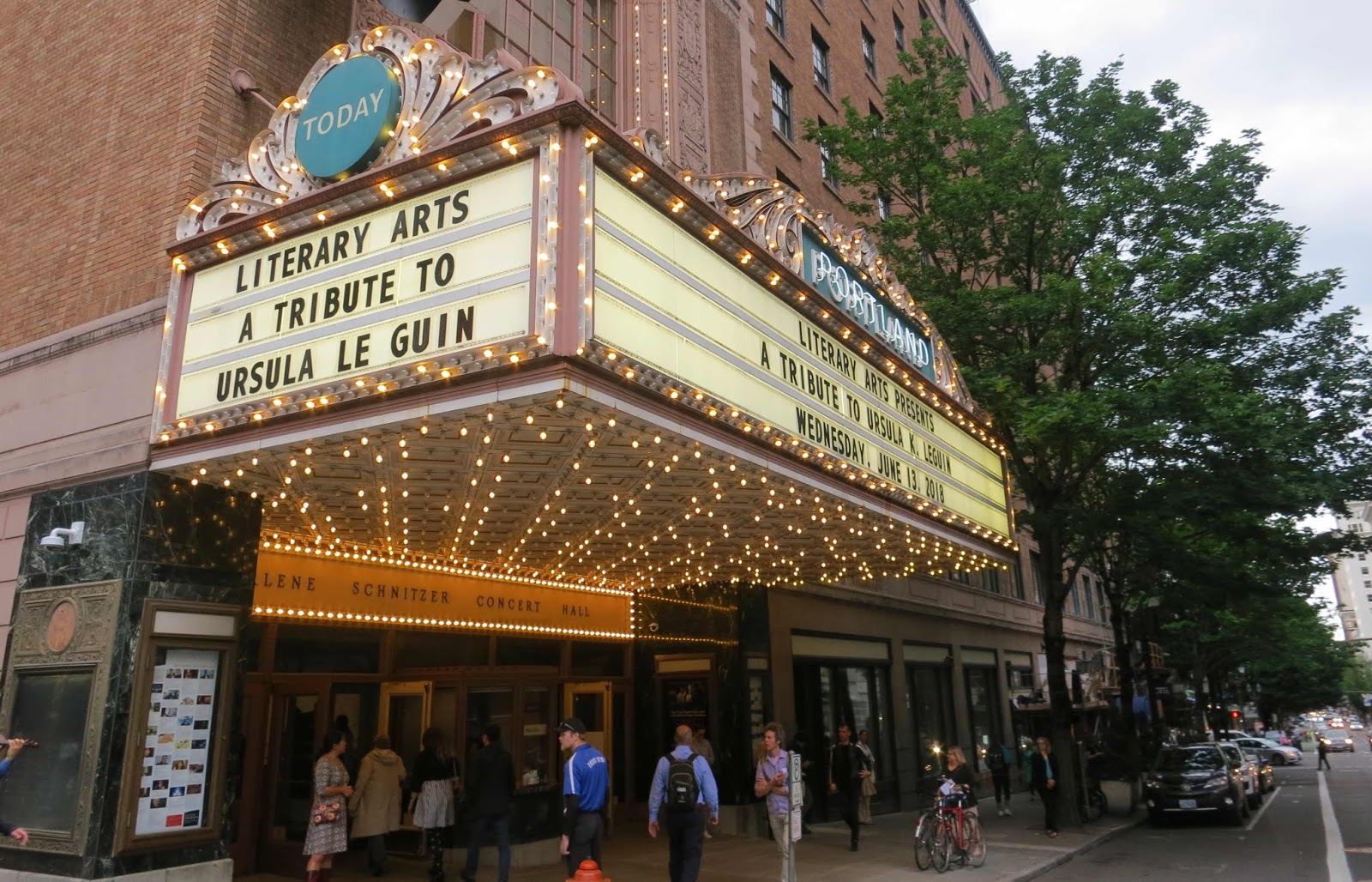
On Wednesday, 13 June 2018, here in Portland, the city she called her own, a group of people devoted to her writing and her life of art convened to celebrate the legacy, still present in our minds and breasts, of Ursula Kroeber LeGuin.

We started out in order to get there at a propitous time and found a parking spot scarcely a block away from the venue, The Schnitz, and within view of the back door of the theatre. As far as omens go, which I don't believe in, this was a good one, so maybe there's something to that.

My life typically does not extend the opportunity for venturing out into such a place. I've lived in Portland for a very long time now, and I tell you truthfully that I have not had the chance to step into the legendary Arlene Schnitzer Concert Hall. It was a happy thing that Literary Arts made this a free event and that I was able to score two admissions to it.

We wuz there.

The evening was a two hour program which interleaved visual media featuring Ursula and brief monologues by artist who had worked with her, been inspired by her, called her friend. It is now a truth that I can say that for a brief, brilliant time I shared a room with China Miéville, Jonathan Lethem, and Portland City Commissioner Chloe Eudaly, all of whom I'm fans of.

Follows a retrospective impression, strained through a cronically faulty memory:

The speakers whom I'd not as of yet heard of, for a variety of reasons, spoke warmly and deeply and affectionately of her. The writer Molly Gloss spoke of an adventure in friendship beginning as a writer's workshop. Walidah Imarisha spoke of the debt visionary fiction has to Ursula and the disappointment (and dissent from Ursula) when the TV version of Earthsea gave us a Ged who was white ... not red-brown, as per the text. Kelly Link told of her experience editing and publishing Ursula for her small press and how her daughter got to be her namesake, and brought the house down with an anecdote where Ursula compared a pissed-off bantam rooser with a Fox News Republican. Daniel José Older spoke with much wit and sass about how Ursula invited us to make peace with, not repudiate, our own dark side, to make ourselves whole. Julie Phillips, Ursula's biography, spoke of her sharp and dry wit. Andrea Shulz, her editor at Harcourt, told of the role she had in brining Ursula's last novel, Lavinia, to print.

Margaret Atwood was there in recorded form, hailing us from the distant planet of Canada. Seems more distant every day.

The stars for me were, of course, Jonathan Lethem, author of Gun, With Occiasional Music, a book I loved, and he spoke of Ursula's power to be a bridge between here and there, between genre and mainstream, between people who didn't necessarily live on the same page; and China Miéville let us all in on a little secret; the incarnation of darkness that Ged released in Earthsea was inspired by the ... of all things ... tardigrade.

Yeah. That cute little nigh-indestructible water bear.

You learn things.


The above photo was taken during the intermission. I didn't snap any photos during the event (that's just rude, and they asked us not to) and on the screen, during the lull and before the event, were a succession of quotations and book covers over the career. I made sure to snap on that included The Lathe of Heaven, and that's what you see above.

The evening ended, after China's monologue, with the quote about how those who deny the existence of dragons are frequently eaten by dragons, which served as the cue for the entry of a troupe of dragon dancers, which will exist in my memory as a happy thing.

Some of my Ekumenical compatriots produced recording devices and used them. Gentle shame on you folks.

The dragon danced its way back out the door and a message on the screen invited us to follow it out to Main Street. I stopped on the way to sign a board where a number of us fans signed, and I paused for a minute, and then something that had apparently been forming for a long time in me catalystically gelled and compelled itself through my arm into the Sharpie pen:


The Lathe of Heaven is my Bible, and George Orr is my savior.

And so a gathering of the Ekumen, with a full house at the Arlene Schnitzer Concert Hall in Portland, Oregon, my town, Ursula's town, town of dreams that if you push hard enough you might change at will (though sometimes that pushing seems of Sisyphean proportion), along with thousands who came in by ansible from locations scattered across the continent and perhaps across the globe, went our separate ways into the night.

We all take a little bit of Urusla with us, of course, in our own ways, in our own minds and hearts.

09 December 2017

Scenes From A Southeast Portland Diner

3533.
Visted Tom's Restaurant and Bar at the corner of SE César E Chávez and Division. This is the third time for me and The Wife™, and this time it was the chili burger for me (which was superb). It's also a great place to simply watch the world go by, as on the CEC side of the building is a busy stop for the TriMet line 75.

The wind was brisk tonight and whipped the awning outside enough to make it feel like it was trying to come into the building. I don't blame it. It's in the 30s out there right now.

Two scenes:


The waitress diva doing her thing as we were cashing out. Tom's, according to the banner, has served Portland in this location from  1975, and it still kinda feels like 1987 in there, but totally in all the good and right ways.


They could totally make a killing with that clock on eBay, tell you what.

We definitely love this place. 13/10, would (and will) eat there again.

11 September 2017

[pdx] Downtown Chevytown, Portland, USA

3492.
That little portion of the inner eastside of Portland that I gave a glimpse of in the last article has a heavy accent of the way all of eastern Portland used to feel, back in the day, and the area still hasn't exhumed the last of that feeling. It emanates because the terrior is, in some subliminal way, preserved. I feel it in the concrete and the sidewalk; in the fact that Andy and Bax is still a Portland thing; the Mediterranean restaurant next to that is still going great guns, and there's still a Wentworth Chevrolet.

courtesy Michael Long on Facebook
In the two-square-block bit of inner SE Portland encompassed by SE Ankeny and Ash Streets, stretching from SE MLK Jr Blvd to SE 6th Avenue, the western one-and-a-half blocks is occupied by the dealership that once fully reveled in the title Wentworth Chevytown. Up until 2013, there was a great and beloved sign over the lot at the corner of MLK and Ash, about four stories tall, with 10-foot-tall red letters reading WENTWORTH CHEVYTOWN. Alas, the dealership, apparently beleaguered by regulation (mostly, they say, having to do with safety regulations pertaining to the high-voltage power lines on Grand Avenue directly in front of the sign) that prevented regular maintenance, deemed it should come down. The Oregonian's Eliot Njus reported the details back in 2013.

Sic transit gloria, and all that. This writing is in 2017, of course, and what changes five years, yes? But Wentworth still abides; there is a Wentworth Subaru (Subaru because Portland) on the block north of that, East Burnside between MLK and Grand, and on the corner of SE Ankeny and Grand, at 134 SE Grand Avenue, the Chevytown mark can still be seen, in appropriate vintage signage.


It is, at least stylish and retro, which doesn't get you as far as it used to get you here in the Rose City, but is still good for something.

The lot in front is another blast from the past, an OK used car lot. These used to be seen pretty much everywhere, and I don't know if OK is still an operant badge for Chevy, but what it was, as Hemmings reports with a bittersweet tone, was Chev's brand for its dealership-sold used cars. And the signs still adorn the block of Grand between Ankeny and Ash.


It gives a certain cadence to the street scene which I greatly enjoy. There was a time when brand and marketing was just kind of a background wallpaper that didn't blare out and cover everything; this reminds me of that.

16 September 2016

[pdx] TriMet's Graphic Design Throwback T-Shirts

3365.
This in over the transom:


It will be recalled that, from the mid-70s,
for about three decades, TriMet made navigating its innumerable routes a bit easier by slicing the Portland area into seven color-and-symbol-coded service sectors: Red Fish (NW and N), Purple Raindrop (NE), Blue Snowflake (NE and E), Brown Beaver (E and SE), Green Leaf (SE and SW), Yellow Rose (SW) and Red Deer (NW and SW). The Brown Beaver can be seen below and to the left in larger size; the simple design of the icons meant that if you going to a certain part of town, all you had to do was find the right color/symbol to guide you to the right handful of routes. I loved this system. It had a flair and a certain Portlandesque panache that was hard to put into words.

Well, times change and so did TriMet; by the middle of the aughts, the system was beginning to evolve away from the hub-and-spoke rationale which made pie-sliced sectors a natural thing, and the multiplicity of rail lines moving through the Portland Transit Mall called for a re-think and a different approach, which works a bit better today if it's a rather characterless.

For those of you (such as me) who fondly remember the old system and don't agree that it was dated, there is a way to fondly remember to others: Throwback gear from TriMet. The seven classic sector symbols are available on t-shirts (such as the one pictured at right) and caps: shirts run in the $16.99 range an the caps run a bit less.

The address for the shirts is http://www.cafepress.com/trimet/10216648, then just select a symbol, shirt or cap, and proceed to check out.

The TriMet gear front page, which includes more than just throwback shirts, is at http://www.cafepress.com/trimet.

03 May 2016

[pdx] A Review of UKL's The Lathe Of Heaven 45 Years In The Making

3321.
One of the more interesting sorts of literary critiques is from those who come to the work late.

The Lathe of Heaven is Ursula K. LeGuin's 1971 masterpiece, a subtext-laden love letter to Oregon and the nature of existence and human affection and love, and the most Portland novel ever written. It clothes its story so well in its setting ... A now-alternate-past version of Portland and northwestern Oregon ... that it's hard to believe that LeGuin wasn't a native Oregonian. It's the novel that caused me to fall in love with her writing, and the way she looks at the world.

At the blog Biblioklept, posted last October, review Edwin Turner posts an intriguing and accessible interpretation of his experience reading the novel for the first time, making a solid case that it's Heather Lelache, not George Orr or Dr. Haber who is the pivotal character of the story. He ends his review thus:
The Lathe of Heaven is a propulsive and intriguing read. I can’t believe I hadn’t read it before now. Great stuff.
To which we say, better late than never.

Read the review at https://biblioklept.org/2015/10/28/a-review-of-ursula-k-le-guins-novel-the-lathe-of-heaven/

14 April 2016

[pdx] Portlandness Is The Atlas Portland Needed.

3316.
There's a section, near the front of the book Portlandness: A Cultural Atlas, (David Banis and Hunter Shobe, $24.95, Sasquatch Books, www.sasquatchbooks.com) which tries to define just what 'Portlandness' is, and then goes on to illustrate just where that Portlandness is thickest. In it, the book's authors, faculty in the Geography department at Portland State University, surveyed students in one of their courses to find out what qualities define life in Portland. The list of answers were largely what one would expect – things like green energy use, breweries, liberal politics, food carts – and they then related these qualities to things that could be measured via GIS and then, plotted the density of these qualities individually and then combined them all into an infographic that illustrated the combined density of all these statistics. 

The results  come off as one might expect: the more you go toward the center of Portland, the more Portland Portland is. Or maybe the more Portlandia. And the assaying is a valuable thing, because it represents a moment in time for Portland, one which our hometown has gone from adorable regional town to the west-coast's 'It Girl'. 

Latterly, Portland has become painfully fashionable and the subject of a national love affair which, if it may be levelling off, shows little sign of abatement very soon, for better … or for worse. Is there a Portland state-of-mind? Is there a way to objectively look at  that peculiar state of being that seems to be Portland and, here in the 2010's, and lay it all out for you, comprehendably? If there is, Portlandness: A Cultural Atlas  comes as close as anything can at the moment ... a witty, earnest look at what it means to be Portland right here, right now

Portland, for all its reputation and buzz, is still on a cusp of sorts. We're still at a place in the national consciousness where we can get either even more popular or pass the crown of the new cool on to another city (sorry, in advance, new city, if we do). But we weren't always this way. There is a story, a context, to how Portland is now and what that's made up of. Portlandness tries to tell that story, as it is now. If 'Portlandness' is a thing, this atlas does its best to describe it as it finds it. In the first part, as mentioned above, it tries to quantify that. 

Portlandness is divided into seven sections, after the introduction which sets the Rose City into a Cascadian context, which group maps and infographics according to overarcing themes: Urban Landscapes, The Once and Future City, Wildness, Views of the City, Social Relations, Food and Drink, and Popular Culture. Amongst them, there's scarcely a base that hasn't been touched, from historic street names to the hauntedness level of various areas of town; one map that combines all the historic plans of how Portland could have grown into one clear-yet-detailed graphic that makes you think of what may have been; the geography of the invisibility of our city's homeless; the interface between the coyotes of Portland and its chickens; a comic on geek culture and its spatiality; another demonstrating how far one is from the nearest indie coffee shop and plots that against Starbucks; a set of set tables demonstrating how long you're going to be waiting for that food at the Screen Door cafe; Chinatown then, and now; the evolution of the Guilds Lake area; a sorely-needed 2-page spread on how the city's annexations have created its shape (my favorite); soccer culture (would you ever doubt? - there's even a set of diagrams showing the loudness levels of various sections of Providence Park during a Timbers/Sounders match), even the story of Maywood Park. One section relates how children see the city, another composites how a group of students in a PSU course made mental maps of the town, characterizing it with their impressions. There's even a map of downtown that shows you the route you must take if you wish to be surveilled by the fewest cameras. And it even tries to answer the question does Portland have more strip clubs per capita than anyone else, making smart side-stop at the reason why that would be.

The design is a tight, disciplined, visually delightful thing, which herds all these infographic cats into something with a grand sense of order. Typography is beautiful, and the infographics are well-done and diagrams you can get lost in. By starting with a strong introduction (which even compares the Portland of Oregon to the Portland of Maine and finds more similarities than you might think) to give a regional setting and context, this book goes beyond mere interesting (and well-designed) fact presentation via infographics and does what a solid reference atlas should do … behave as a snapshot of a moment in time of an important time in the story of the place that is Portland. 

This is a fine book that I really can't put down for long, and anyone who loves, is intrigued by, aggravated by, or loves from afar Oregon's biggest town really should find a space on their shelf for it. 

The Portland of 2015 is a curious thing. Portlandness: A Cultural Atlas is the atlas Portland needs for this time. I'm kind of hoping that the authors decide to do a 2nd edition sometime down the road. 

The comparison would be epic.

Portlandness: A Cultural Atlas, (David Banis and Hunter Shobe, $24.95, Sasquatch Books) is available via Sasquatch's website (http://www.sasquatchbooks.com/book/?isbn=9781632170002&portlandness-by-david-banis), which also has links to other places you can purchase the work.

18 March 2016

[pdx] Sellwood Bridge Bonds: Same As It Ever Was …

3307.
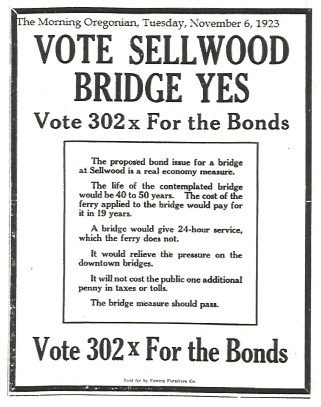
One of the bits of ephemera given out at the Sellwood Bridge grand opening a few weeks back now, was this, printed on the back of a card given out by the Multnomah County Elections Dept to encourage y'alls to use your damn' franchise. Here it is. Most ironically illuminative:


It enumerates the various benefits the bridge would bring. Most unintentionally amusing is the point that The life of the contemplated bridge would be 40 to 50 years. The ad, as the attribution notes, was published in The Morning Oregonian in November of 1923, and the bridge would actually debut just slightly more than 2 years hence.

Given the cited lifespan, the old Sellwood reached its pull date in 1975. Interesting to think that they figured that a 50-year bridge would fix the need adequately. And, of course, the debate over taxes is an evergreen one.

Also, those fonts? Love those fonts! Those fonts just speak loudly of their time.

02 March 2016

[test] Resolved with GIMP, Posted with Firefox under Ubuntu. Still Portland.

3283.
Downtown Portland, from SW Jefferson St and 14th Avenue, looking east. This is a picture I took sometime last year, and am posing from a Ubuntu-enabled laptop in order to see if I can migrate my blog post workflow to another machine if necessary, or desired.


On the left there, down the street, is the Wells Fargo Tower. On the right, the rocketship, is the KOIN Center.

10 February 2016

[liff] A Madeleine Moment, A Block From Powell's Books

3258.
I'm not, emphatically, one to take pictures of my food and post it on line, but for this, I make an exception.

There is a branch of Peet's Coffee on NW Couch Street Between 11th and 12th Avenues, in the place  that used to be Blitz Weinhard's brewery, and they do have the loveliest salted caramel latte. And they had madeleines!

This is what reading Proust does to one. So be it.

The biscuits of interest, with accomplice.
So, we have madeleine moments, just not as profound as Marcel's. The madeleines come three to a package and while they're locally baked, if you leave a madeleine out, it's this little cakey thing, and it'll go stale, and that'd be a shame. And while it's not as profound as Marcel's, the taste of the cream at the top coated with the salted caramel covering the end of the madeleine you've dipped thereinto gives you an idea of where a gourmet's palate might go when its owner dies.

And just down the street, Powell's City of Books … so it's not only delicious, it's painfully Portland on more than one level.