Showing posts with label Portland Bridges. Show all posts

06 July 2024

What Kind of Burnside Bridge Do You Want For The Future?

4161While the process grinds forward on the redux of Interstate Bridge 2.0, the process is rolling along quite smoothly on the planning to replace the Burnside Bridge.

The current bridge is gorgeous, laden with history, a classic of design, a linchpin of Portland's geography, and will collapse like a Republican excuse for not doing the right thing when Cascadia Next happens. It's apparently advantageously situate for keeping the city together in the wake of that anticipated cataclysm, so the goal is to have a Burnside Bridge that will not shake down when that 'quake finally happens.

In the apres-quake times, the most important thing for getting Portland back on its bearings ... however long that will take ... will be eastside-westside connectivity and access.

The opporunity is being taken to make the new-Burnside-Bridge-to-be another example of statement architecture that we Portlanders are so very fond of. There are two options to consider; a tied-arch bridge, similar to the Fremont Bridge, and an cable-stayed bridge, using the technique that was built into the Tilikum Crossing. 

These two styles are asymmetrical; the signature architectural part, the arch in the first case and the cable-stay tower support in the second, will be over the Interstate 5-east end of the bridge, leaving a span over the middle of the channel for a the necessary drawspan for river traffic and for making Portland tourist wonder why they had to stop on the bridge in the middle of the day.

There are also variations on each style. This picture, sharked from the Earthquake Ready Burnside site, shows the beauty profile of the tied arch look from a point in Tom McCall Waterfront Park on the west bank:

Source: https://burnsidebridge.participate.online/tied-arch.html

Driving over it will look like this ... which reminds me of a crossing of the Fremont, which has always been a love of ours:

Source: https://burnsidebridge.participate.online/tied-arch.html

The other option, the cable-stayed version, looks this way:
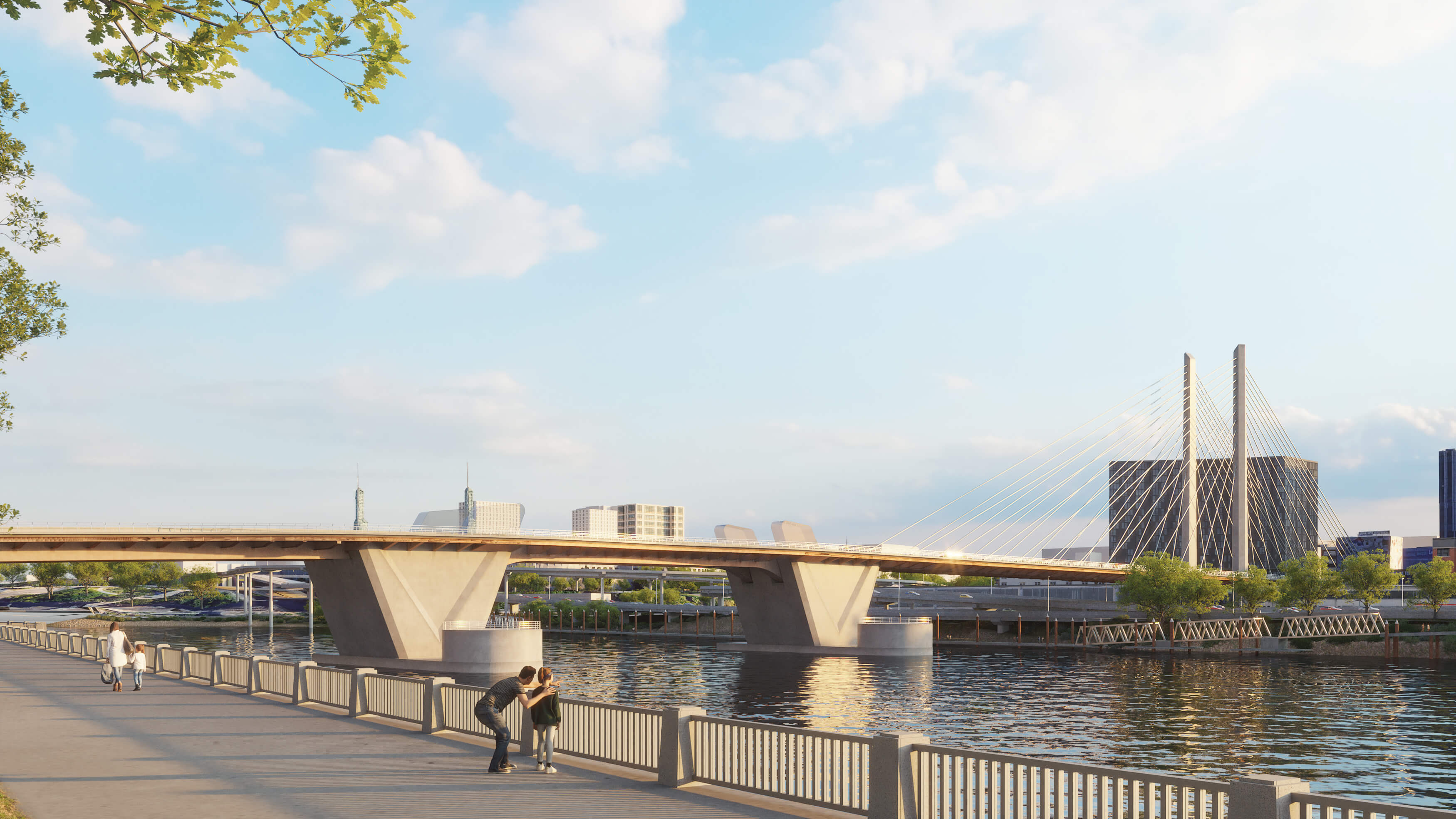
Source: https://burnsidebridge.participate.online/cable-stay.html

This version will have taller towers than the arch-style, but the visual presence isn't there for me. However, the asymmetry of the cable stays does have a element of dynamic style in it.

There is a survey on line that anyone can submit their opinions and personal preferences into, it's found at https://burnsidebridge.participate.online/survey.html. The homepage of the informational website is https://burnsidebridge.participate.online/, of course. 

In the near future, this bridge will close for a remarkably-long five year span for this replacement. I don't even remember the Hawthorne Bridge being closed for that long back in the 90s when they updated the eastside approaches.This will be something to contend with for a lot of us on all levels. I'll be recording everything I can about it and posting it here as I go.

We were there for the opening of the 21st Century Sellwood Bridge, and I'll put my anchor down here; I'm looking forward for us to be there for the opening of the 21st Century Burnside Bridge as well. In the meantime I'm going to be finding us taking many more pictures of the current span; it's a charming architectural gem, and that passing will be notable. 

01 October 2022

The Far End of SE Stark Street - The Stark Street Bridge

4071

Here, in the woods just a minute east of Troutdale, at the brow of the bank of the Sandy River, is where SE Stark Street, in its long traverse, comes to a rather abrupt end.


The end of Stark curves around the top of a bluff above the Sandy River like a crooked finger, dropping as you go east. At this point, I'm actually facing northwest which somewhat disorients if you're familiar with Stark on the east-west gridiron. 

The far end of the bridge is a t-intersection with Historic Columbia River Hwy on its way out to Springdale, Corbett, Vista House, and points east in the Columbia Gorge. I am on the end of the Gorge here; that bluff on the other end of the bridge is one of its ramparts. This is as far east as SE Stark Street goes; there is no more after this.

The Bridge is rather narrow. Doing what I do now, I have to occasionally drive a truck over this bridge. That makes me hyper-aware of how narrow this bridge is. But nothing amiss as long as you take it slow and easy. 

13 June 2021

Bridge Day #2: The Fremont Bridge

3942

Bridge number two of Bridge Day is one of the ones built during my lifetime. As a matter of fact, I got to watch it on TV ... had to, I'd say. I was living in Silverton at the time.

The Fremont Bridge was the final link in the inner city freeway loop that is formed by I-5 and I-405. It is a tied-arch bridge, and made news because the center of the span was fabricated in California, assembled just downriver on Swan Island, and barged from Swan Island to the worksite, where it was hoisted into place using 32 giant hydraulic jacks. 

They telecast the beginning of the lift early one evening in March 1973. I don't know how long it took but the allotted program time wasn't near enough long, I'm certain.

A schoolkid at the time, I made numerous drawings on looseleaf. It became something of an obsession.


It's almost 400 feet up to the top of that arc from the river. It also has a nest of peregrine falcons.

Bridge Day #1: The Broadway Bridge

3941

Today is Bridge Day for no other reason than I had three bridge pictures to post.

We at The ZehnKatzen Times do not plan on making this a repeating thing, although I live in a city that has bridges and I adore them, they'll sneak in here from time to time.

None of them are pierless, I'm afraid.

From last week, then, a bridge I don't have so many pictures of: the Broadway Bridge. It's a Rall-type bascule (Rall after the man who devised this particular method, and bascule meaning drawbridge with a leaf or two leaves as the draw span) that was built in 1913. It connects Broadway on the east to Broadway on the west, and that precedence is important because Broadway, in Portland, was born on the east side and only became a west side street after this bridge connected it to Seventh Street North and the name was extended. 

Until the Great Renaming, it was known as Broadway south of Burnside, Broadway North north of Burnside, and East Broadway east of the Willamette.


The connection, which completes a stringing of Broadway through four of the city's now-six address areas, makes a most unique route of Broadway, technically both a Street (east of the river) and an Avenue (west of the river). As I understand it, though, the correct rubric is simply Broadway, no Ave or St, though there are some older blades on the east side that may still say NE Broadway St, and are being superseded by the new-look street blade design.

The design of the lift mechanism makes for some slow bridge lifts. Multnomah County's page on the Rall design cites it as the slowest lift of all the bridges, with average lift times of ten minutes.

Having been caught on the Broadway during some of those lifts, I can confirm. It takes forever. If you have to be somewhere and time is tight, use another bridge, if you can.

You'll thank me later for this advice, I'm sure.

30 May 2021

Tilikum Crossing, In Passing, From the West

3919

This is a view of Tilikum Crossing from the seat of a car travelling northbound on Moody Avenue, just south of the intersection where all the transit traffic comes and goes from it.


It's quite a beautiful bridge, and that's actually a change of mind for me. I love the way the cable-stayed design makes it look like a suspension bridge. At first, I wasn't that big a fan, but that was then. 

They're going to try to build a new Interstate Bridge, while I'm woolgathering about it all, and I hope they take some inspiration from this, amongst other things. Columbia River Crossing 1.0 was going to be a dreary, boring thing. A bridge in that spot, linking Portland and Vancouver, should be a majestic, impressive thing. 

Maybe a suspension bridge? I can hope.

23 May 2021

The Tilikum Crossing In Profile

3895

A most agreeable angle can be had of the Tilikum Crossing (full and complete title: Tilikum Crossing, Bridge of the People) on the walkway along the extension of River Parkway south of the Marquam Bridge.


The cable-stayed span is a rather beautiful design, if only because it resembles a suspension bridge. It's a change to the landscape, and I adore it.

21 May 2021

The Bridges Of Multnomah County

3891

A look north, downstream of the Willamette, showing the several bridges that unite the core of Portland. The big one, up front, is the Marquam Bridge, the one that carries I-5 over the river, and the trusses of the Hawthorne is clearly visible, but even though one can see bits of the Morrison, Burnside, and Steel, they obscure each other and you can see only hints of them.


I've always adored the Marquam. It's got a graceful arch to it and the way it gracefully swings between the west bank and the east bank, doing its job without bragging, and largely unappreciated for it. 

But I think it's gorgeous.

17 May 2021

A View Through The Bridges

3882

Another view upriver from my Steel Bridge viewpoint. 

I didn't get precisely the view I was hoping to - I don't know if such a thing is achievable - but I did get zooms that, if not calendar for frame-worthy, certainly have interest, as far as I'm concerned.

The view is, again, looking south, or upriver. What's in full view is the bascule leaves of the Burnside Bridge's lift span, and what is in view through there are truss approaches to the Morrison, with the glimpse of the Hawthorne through that. The towers in the distaance are the condo silos of the South Watherfront.

The thing I really want to draw attention to are the two 'conning towers' on either side of the Burnside's draw span. They are lovely and quaintly decorated and look very pretty up close. Anyone gets down there, please give them a lingering look. They are visually very delightful.

04 May 2021

Fremont, Broadway, and Louis Dreyfus Dock

3849

This is basically an angle of what you see if you took my viewpoint on 3848 and turned 180 degrees.


The red truss is a part of the Broadway Bridge, and the great arch beyond is an irregular visitor to this block, the nearly-iconic Fremont Bridge. The Louis Dreyfus grain elevator is there on the left, and beyond the bridge the boutique condo district that NW Portland has become gives way to what remains of the working port district on the Willamette's right bank.

The grittiness of the area lives on as an echo, but that's getting attenuated as the money comes in. And so it goes. 

The Blue Heart Of Portland

3848

Looking south from the vicinity of the Steel Bridge is looking up-river along the Willamette, in the reach that extends through Portland's veriest city center. There are many bridges and so very many new buildings, most of which you see in this shot did not exist fifteen years ago (again, same planet, different world ... Saint Ursula was prescient in a way).


On the right, downtown; on the left, the burgeoning central east side. Going from foreground to background we see, in whole, the Burnside Bridge, and in parts: the Morrison Bridge, the Hawthorne Bridge, the Marquam Bridge arching above them all, and if you look sharp, one of the towers of the Tilikum Crossing. 

And this is Portland's Blue Heart. 

01 May 2021

The Multimodal Bridge

3844

Multimodal is a funny word. It's clear what it means but it gets used so much by city and transit planners it sounds like one of those power-buzzwords that get hammered to death on resumes.

But multimodal is what the Steel Bridge is, a bridge that, in its hardworking way, links the halves of Portland like no other. Here it is, doing what it does best. Multimodally.


There was, back in the 1980s, before there were multiple MAX lines, the possibility of driving through the middle part of the structure, where that oncoming MAX is right now. It was fun to find yourself driving in front of a train, or with one on the left side of you. As the lines multiplied, though, they took the middle of the bridge for MAX lines only, and relegated cars to the two outside lanes. 

The approaches to the bridge have seen much revision over the past 40 years. 

Willamette River Close-up at the Steel Bridge

3843

The zooming in to make the bridge frame the glimpses of city beyond is always a bit of an irresistible compulsion to me, as is bumping the color up a little.

It's the struggle between fidelity to reality and fidelity to memory; the colors may be more vivid than they were in reality, but they're exactly as vivid as they are in memory. And the satisfaction in devolving the shapes in the girders and the structures they frame by disconnecting them from what they connect to in the greater sense, that makes them make more sense, and making them a more abstract thing is something I also cannot turn away from, and it's satisfying

.  For information's sake, the red truss over the river beyond the supports to the Steel is part of the Broadway Bridge, and the small blocky apartments was once known as McCormick Pier, though it may well have changed its name. Everything down in that area of town has. 

Even the graffiti seems to support the artistic view of the place.

The Steel Bridge, Portland, Oregon, 2021

3842

This is a steel bridge, and it's called the Steel Bridge, and, at one time, it connected the east and west sides of the Willamette River, in Portland, in a pivotal way by being the route US 99W, later OR-99W, crossed the river. Now, it's the pivotal point in the TriMet rail system, carrying all MAX lines over the river except, I suppose, the Orange Line, though the Orange, which brings people in from Milwaukie, becomes north Portland's Yellow Line as it courses through the Transit Mall. At least, I think it does.

It's not the first photo I've ever taken of the Steel, but it's one of the best. It shows off all the charming detail and some of the structural features that make it so unique.


There's an elbow bend of the Willamette in the center of Portland, just north of where the Burnside Bridge crosses, and this is about the narrowest point of the river within Portland city limits. It's at this point the Steel crosses. 

The original Steel Bridge was a swing span in this location, but the current bridge dates from 1912, making it 119 years old, more or less, at this writing. It can be seen from this angle that it's a double-deck bridge and that rail and bike/ped traffic has the bottom whereas car and rail traffic has the top. What's unique about that drawspan is that the bottom retracts into the top, meaning when river traffic needs to pass, if it can clear the un-lifted traffic deck only the lower rail deck needs to lift. 

This makes the lower deck dangerous to be on if one should be so foolish as to use the inside rail deck as your crossing. We recall stories of people being trapped on that deck on lifting, before there was a ped/bike walkway there; their destiny was to be crushed to death between the two decks. 

The bridge in this shot is doing what it does best, linking the east and west sides of the Rose City via transit-rail; a newer MAX bound to the Rose Quarter, an older MAX bound for the Portland Mall. Wikipedia claims it's perhaps the most 'multimodal' bridge in the world; the only double-deck lift bridge with independent lifts, and the second-oldest vertical-lift bridge in the world, second only to the Hawthorne, which is just around the corner. 

It's old and new, rustic and modern. A contradiction in terms that somehow makes perfect sense.

19 April 2021

Moody Night Shot of the Fremont Bridge, 2007

3826

For our last throwback of the day, here's a view, lens flare through plastic optics and all, of the Fremont Bridge at night, taken on a March night in 2007.

This photo is the perfect backdrop for hard-boiled Portland-style detective tales, retro-future atmospheres, and anything that just needs a moody, after-dark, bridge-lit, fourteen-year-old patina. Contact us for details.


06 April 2021

Four Portland Bridges In One (Picture): 2018 Throwback

3811

Other cities have more bridges, other cities have fewer but more spectacular bridges, but Portland, with a mere seven traffic crossings over its modest yet muscular dividing river has a rep as Bridgetown which extends well beyond its limit.

Maybe because, in the gestalt way, Portland's bridges draw the line between number, function, design, and majesty to accidentally arrive in a certain picturesque sweet spot. The modern lines of the Morrison Bridge are sublime; the antiqueness of the Burnside, the rusticness of the Steel, are, to me, more memorable than the majesty of the suspension spans linking New York boroughs. Even the Saint Johns, despite its quaintness, emanates a combination of poise and elegance that the Golden Gate Bridge can't match. 

But that's me; I, even in the evolved Portland of today, am ever the PDX-chauvinist. Home-town pride and all that.

There's another more practical niftiness about the bend of the Willamette through the dead center of the Rose City; it affords unique angles that allow me to combine more than one bridge most attractively into one shot. For instance, if you situate yourself in the proper place, about 2/3rds of the way east over the Burnside from downtown, you get this:


Four bridges in this shot: in the distance, the arch of the Fremont; next nearer, the red trusses of the Broadway; one more in, the prehistoric Steel, and the balustrade of the one I'm standing on here, the Burnside. Through the gaps in that balustrade you see a car cruising along a ramp from the Banfield Freeway westbound to I-5 along the river southbound; if you look carefully between the supports of the Steel you see a bulk ship standing by to either unload or go; and on the right peeks out the Louis-Dreyfus grain dock elevators.

There are probably other river scenes in other river cities where you can combine nearby elements for an interesting view, but my heart tells me they can't really compete with this even before I've looked at them. 

Interestingly, despite the preponderance of 2010-2013 throwbacks from the now-decommissioned Kodak EasyShare C813, this was actually taken in 2018 according to the EXIF data, so it isn't a throwback ... more of a gentle shoveback.

04 April 2021

The Mountain And The Port

3808

The Columbia, as I've said, is a working river.

A hard working river, it must be further defined.

And it does it all beautifully, tended to with care (some enlightened, some misguided, but that's what you get with humans) by all who are deemed temporally responsible for it. It throngs with ships but doesn't seem overwhelmingly polluted; you can walk the shores and the water seems fresher and cleaner than you'd expect, and it's in the most unique setting, with one big town on each bank but majestic volcanic ranges within easy sight.


Those port facilities are on the north bank of the Columbia, a Port of Vancouver terminal in Washington. We, of course, view from the Oregon side. I don't think Wy'east has much of a care or knows what a state is; to Wy'east, it's all one and the same. It's been here before any of us came, and it'll be here long after we go.

Here's a pan-right and extreme closeup looking up river:


That most distant bridge with the two towers and the cable between is our beleaguered and imaginatively-named Interstate Bridge, that's where I-5 crosses. The truss in the middleground is the railroad mainline bridge. The Cascade crest, beyond. It's a big world, my Willamette Valley, but surprisingly narrow. 

03 April 2021

The Steel Bridge, April, 2010

3805

This was taken the same day the previous entry's was, too; end of April, 2010, this being Portland's venerable Steel Bridge as seen from the parking structure at NW Naito Parkway between Couch and Davis. Beyond that, the Louis-Dreyfus grain dock. 

The framing of the picture probably means that you could take the same shot and it wouldn't look terribly different.


15 September 2020

Two Bridges, Five Days Ago

3761

In the missive previous I mentioned our inbound and outbound travel. Two bridges were involved:

The Broadway Bridge, here seen from N Interstate Avenue back of the old Memorial Coliseum:

And the transport outbound was the venerable Steel Bridge. The smoke is not as evident in this, but the drabness of what is usually a fairly colorful shot should be obvious.


20 August 2020

The Marquam Bridge from The Portland Tram, 2008

3744

Now one might have credibly argued that perhaps I should have grouped this with the last three, in as much as they were all taken from the Portland Aerial Tram on the same day in the same year, thence the thematic connection.

But the Marquam Bridge holds a special place in my heart. It does its job, day in and day out, with no nonsense or fanfare about it, everyone depends on it, and nobody sees the inherent beauty in it. For anyone who does their thing because people rely on it even though nobody appreciates its positive qualities much, this bridge could be your patron saint.


18 July 2020

Tilikum Crossing From Terwilliger Blvd

3723This, the full name of which is Tilikum Crossing, Bridge of the People, is the newest and most unique of Portland's signature bridges, a cable-stayed design that opened to the transit- and bicycle-using public in 2015. It is not a general traffic bridge, but is restricted and designed for buses, light rail and streetcar, and bicycle and pedestrian access only. It connects from the west at a point off South Moody Avenue just south of the Riverplace district and ties into the east via a access called SE Tilikum Way which bends to become a block of SE 7th Avenue feeding into SE Division Place. It opened in 2015.

A public naming contest was conducted; Tilikum Crossing wasn't the popular choice but the choice TriMet went with. The popular choice was honoring the legendary street performer "Working" Kirk Reeves, may he long live in our hearts, but that just didn't have the gravitas that they were looking for, we guess. That said, the word tilikum is Chinuk Wawa meaning people in the sense of family or tribe and meant to pay homage to the indigenous inhabitants ... the Multnomahs, the Clackamas, and others who lived here before we white people go there, and if they weren't going to go with the people's choice, at least they went with something with a lot of heart and Native soul.


Interesting Fun Fact!: The bridge, as mentioned earlier, is transit and pedestrian/bike only. So, as you sit comfortably (and properly socially-distanced) in a TriMet motor coach or a MAX train, you can grin smugly at the people crossing in cars just to the north via the Marquam Bridge or to the south on the Ross Island Bridge. Of course, they're too far away to see you; the victory is a Pyrrhic one. It is, never the less, real, and yours.