Showing posts with label map design. Show all posts

05 September 2017

[maps] Salem, Oregon, Within Her 1956 Boundaries

3485.
I'm leaving this here as a pretty and a bauble and a sort of a bookmark, and also drilling down into some more interesting detail of the 1956 Oregon Official State Map.

The back of the map has, as intimated, a number of insets giving detail of larger Oregon towns. One of the more important would be, of course, the state capital - then, as now, doughty Salem. The 1950 Census, as recounted in the city list in the index plus, one would assume, estimates for the six years thereunto, give a population for Salem as 43,140 (today's population is around 165,000, headed for 170,000, which is a change from my own childhood my mind's still having trouble encompassing). According to the state map, Salem laid out about thusly:


I could look at that hand-done lettering all day, it's so charming.

Okay, anyone familiar with the current geography of Salem will probably gasp a little at how small she was. Commercial Street, the main drag south (labelled BUSINESS 99) ends, in this panel, right at the point where modern-day Liberty Road forks off, or just south, where Vista Avenue crosses. By the time the late 60s were around, barely a decade later, the city had annexed Commercial all the way out to where it merged with what was then being called I-5 (and what was being called BY-PASS 99 in this map). The city also breached the bypass freeway on the right by the mid-60s. Another obvious difference is that what we today call Market Street NE is, on this map, outside the modest city limits, anyway, "Garden Road". Swegleing to the freeway would have to wait a few years.

I'm going to try to combine information from this and another map to tell a third story. It won't be a complicated one, but it'll be a story that I enjoy being told and telling again. Check back here for that.

04 September 2017

[maps] Portland to Salem, from the Official Oregon State Map of 1956

3483.
As a companion to the Portland-Salem map I posted a few days back, which see, I give you this clipping, which is from a circa 1956 Oregon official state map.

And what a visual difference there is.


... and what a difference there is, yes? This is handcrafted, a thing that went out of style in the Pacific Northwest for about half-a-century before coming back into vogue with the coming of the microbreweries. A steady, practiced, passionate hand accomplished this work. 

All the place names we know so well are there, including one that not longer is (note the "To Valsetz" director in the lower-left-hand corner of the map, a little south and west of a small place called Falls City). The footprint of the City of Salem was appropriate for the city limits during the 50s, but seemed to survive on Oregon state maps well into the 70s, after the city had annexed much territory (as noted in that entry on that map).

While the roads are largely where they were going to be, a few reroutings strike some intrigue. 99E and 99W area still US highways at the point. Longtime Salemites will no doubt be delighted by the old routes of Hwy 22 going west and east - particularly Hwy 22 to the east, a great diagonal expressway reaching out to just east of Stayton, follows a much more circuitous route. That can still be followed today, if one cares to, by going south on Lancaster Dr SE until it becomes Aumsville Hwy SE. Follow that back road to Stayton and you'll get a hint as to how our grandmothers and grandfathers got out that way.

You'll also find US 99 north from Salem in the familiar alignment of today's I-5. The Interstate highway system was just aborning at that point. The bridge over the Willamette at Wilsonville was, at most, only a fraction of a year old by this point (it opened sometime between 1956 and 1958). Also, State Hwy 217 in the Beaverton-Tigard area followed a route that still exists today as SW Hall Blvd to Tigard and SW Boones Ferry Rd from Tigard south to Wilsonville.

And, while well-served by paved roads, a great deal of the mid-Willamette Valley could only be gotten to by gravel roads. Modern times were still a few years off for some of these places (and indeed could be argued they still haven't gotten there - modern times being what they are, that might actually be an asset, these days)


27 August 2017

[maps] Oregon State Offical Map 1971, The Mid- and North Willamette Valley

3479.
This is a further scan from the 1971 Oregon-official state map I've uncovered. The previous map scan was of an inset-map from the back of the map, where city detail thumbnails and lovely state photographs can be found. This particular one is from the front, and is clipped from the main state map.

The ardent reader will by now have noticed the fold-marks, dark areas, and some areas slightly out of focus. All an occupational hazard when scanning maps that have spent the better part of the last twenty years folded and scanned in on a desktop scanner; please excuse the technical difficulty.


Only cities north of 30,000, give or take, are given the dignity of footprints on this map; the yellow-outlined areas are meant to give an idea of the expanse of the incorporated areas of the towns. Still, the were rather out of date at that time; the city limits detailed for Salem are more appropriate for about 1955-60, rather than 1971, which was about the time urban growth in Oregon really picked up steam.

At the time, that inaccuracy infuriated me; now, it's the most charming thing in the world, as is the kind layout, the conservative choices of colors and typefaces (especially for the larger town; the thickness and the squashed aspect ratio of that type has a subtext of cheerfulness, approachability, and friendliness.

A sort of "Oregon nice".

14 April 2016

[pdx] Portlandness Is The Atlas Portland Needed.

3316.
There's a section, near the front of the book Portlandness: A Cultural Atlas, (David Banis and Hunter Shobe, $24.95, Sasquatch Books, www.sasquatchbooks.com) which tries to define just what 'Portlandness' is, and then goes on to illustrate just where that Portlandness is thickest. In it, the book's authors, faculty in the Geography department at Portland State University, surveyed students in one of their courses to find out what qualities define life in Portland. The list of answers were largely what one would expect – things like green energy use, breweries, liberal politics, food carts – and they then related these qualities to things that could be measured via GIS and then, plotted the density of these qualities individually and then combined them all into an infographic that illustrated the combined density of all these statistics. 

The results  come off as one might expect: the more you go toward the center of Portland, the more Portland Portland is. Or maybe the more Portlandia. And the assaying is a valuable thing, because it represents a moment in time for Portland, one which our hometown has gone from adorable regional town to the west-coast's 'It Girl'. 

Latterly, Portland has become painfully fashionable and the subject of a national love affair which, if it may be levelling off, shows little sign of abatement very soon, for better … or for worse. Is there a Portland state-of-mind? Is there a way to objectively look at  that peculiar state of being that seems to be Portland and, here in the 2010's, and lay it all out for you, comprehendably? If there is, Portlandness: A Cultural Atlas  comes as close as anything can at the moment ... a witty, earnest look at what it means to be Portland right here, right now

Portland, for all its reputation and buzz, is still on a cusp of sorts. We're still at a place in the national consciousness where we can get either even more popular or pass the crown of the new cool on to another city (sorry, in advance, new city, if we do). But we weren't always this way. There is a story, a context, to how Portland is now and what that's made up of. Portlandness tries to tell that story, as it is now. If 'Portlandness' is a thing, this atlas does its best to describe it as it finds it. In the first part, as mentioned above, it tries to quantify that. 

Portlandness is divided into seven sections, after the introduction which sets the Rose City into a Cascadian context, which group maps and infographics according to overarcing themes: Urban Landscapes, The Once and Future City, Wildness, Views of the City, Social Relations, Food and Drink, and Popular Culture. Amongst them, there's scarcely a base that hasn't been touched, from historic street names to the hauntedness level of various areas of town; one map that combines all the historic plans of how Portland could have grown into one clear-yet-detailed graphic that makes you think of what may have been; the geography of the invisibility of our city's homeless; the interface between the coyotes of Portland and its chickens; a comic on geek culture and its spatiality; another demonstrating how far one is from the nearest indie coffee shop and plots that against Starbucks; a set of set tables demonstrating how long you're going to be waiting for that food at the Screen Door cafe; Chinatown then, and now; the evolution of the Guilds Lake area; a sorely-needed 2-page spread on how the city's annexations have created its shape (my favorite); soccer culture (would you ever doubt? - there's even a set of diagrams showing the loudness levels of various sections of Providence Park during a Timbers/Sounders match), even the story of Maywood Park. One section relates how children see the city, another composites how a group of students in a PSU course made mental maps of the town, characterizing it with their impressions. There's even a map of downtown that shows you the route you must take if you wish to be surveilled by the fewest cameras. And it even tries to answer the question does Portland have more strip clubs per capita than anyone else, making smart side-stop at the reason why that would be.

The design is a tight, disciplined, visually delightful thing, which herds all these infographic cats into something with a grand sense of order. Typography is beautiful, and the infographics are well-done and diagrams you can get lost in. By starting with a strong introduction (which even compares the Portland of Oregon to the Portland of Maine and finds more similarities than you might think) to give a regional setting and context, this book goes beyond mere interesting (and well-designed) fact presentation via infographics and does what a solid reference atlas should do … behave as a snapshot of a moment in time of an important time in the story of the place that is Portland. 

This is a fine book that I really can't put down for long, and anyone who loves, is intrigued by, aggravated by, or loves from afar Oregon's biggest town really should find a space on their shelf for it. 

The Portland of 2015 is a curious thing. Portlandness: A Cultural Atlas is the atlas Portland needs for this time. I'm kind of hoping that the authors decide to do a 2nd edition sometime down the road. 

The comparison would be epic.

Portlandness: A Cultural Atlas, (David Banis and Hunter Shobe, $24.95, Sasquatch Books) is available via Sasquatch's website (http://www.sasquatchbooks.com/book/?isbn=9781632170002&portlandness-by-david-banis), which also has links to other places you can purchase the work.

08 March 2016

[map] Mars, As The Medieval Explorers Saw It

3294.
Well, naturally, there weren't medieval explorers on Mars, but there should have been, and with Eleanor Lutz' map, you can pretend there were. An excerpt:


The antique look is nailed exactly, precisely, and satisfyingly. Using authentic-looking fonts and a razor-sharp eye for the style, Eleanor has lovingly recreated the style of medieval mapmakers on a world that's never seen humans, complete with hints as to name origins and official looking seals denoting probe landing sites, with portolans emanating from them for the win. Forming the basement to the art is official NASA photos of Mars to help fix the artistic geography to the real, and tie the whole look together.

Eleanor is a PhD student at the University of Washington whose passion is art and infographics; she's been published in various places including Popular Science and the International Business Times; and judging by her FAQ, she's a smarter person than I'll ever be … and she has the wit of a Karen Wynn Fonstad.

Her blog, where you can buy the above and get to know her work better, is TableTopWhale.com

(H/T to The Wife™)

11 April 2014

[maps] A Country By Any Other Name … Or What It's Name Really Means

3053.
The maps in the series The Atlas of True Names sound fantasy-novel-ly.

Heart's Farm and Place By The Meadow are major cities in the Land of Friends whose capital is The Illustrious One. This fabled land is found as a part of The United States of the Home Ruler, which is one of the main nations in this fantasy-tinged land.

Actually, it's a land not far from here. If you know the root meanings, you might have guessed that I mentioned, in order,  Houston and Dallas, which are the biggest towns in Texas which has Austin as the capital city. By now, one has probably deduced that the cartographers have made an effort to locate the root meanings of the words we casually use for our world's place names and brought those meanings forward into English. Thus, Canada becomes Land of Villages (one interpretation of the First Nations word kanata being village) and Mexico being Navel of the Moon (the modern nation takes its name from the Valley of Mexico (present day Distrito Federál), which took its name from the Mexica, the 'People of the Moon').

How the USA became the United States of the Home Ruler is kind of fuzzy to figure, but we know that the word America was drawn, as many readers will know, from Amerigo, as in the explorer and mapmaker Amerigo Vespucci, courtesy of Waldsemüller. The name Amerigo, as this site notes, is a medieval Italian version of the German Emmerich; it speculates that the forepart of that comes from a word meaning home, and the aft part, a word meaning power, so the reasoning normalized that into home ruler.

But, you may wonder, what of our beloved Oregon? Here you are, from the zoomable version that can be seen at http://twentytwowords.com/united-states-map-with-place-names-replaced-by-original-meanings/:


There's not much, but what's there is amusingly interesting. Portland obviously has no other meaning. our capital city, Salem, is an Anglicized version of the hebrew shalom, meaning peace; Well-born is an obvious rootation of Eu-gene. Mishap Lake for mal heure is a good translation of the southeastern Oregon place name essentially meaning bad luck or misfortune. I don't know what exactly the Realm of the God of the Underworld is supposed to be: Madras was named after the cloth, Redmond was named after its founder, whose name is an Anglicization of an Irish name which is a Celticization of the name Raymond, whose meaning has nothing whatsoever to do with Hades.

Although, it does get intolerably hot in the Oregon desert in the summer months,  it ain't that bad.

The most intriguing rendering is that of Oregon into Beautiful Land. That contradicts every guess as to where the word Oregon came from, and that's something that nobody can say for certain. There are many good guesses that make sense, but the best explanation that I can logic out from it all is that we call this place Oregon because that's what we thought the people who were here before us called it.

Beautiful Land is something I can't figure where they got.

Maybe they vacationed here once. Because it's correct enough …

As mentioned, a zoomable version of the map is located at the article at Twenty-Two Words: http://twentytwowords.com/united-states-map-with-place-names-replaced-by-original-meanings/, and the home page of the Atlas is http://www.kalimedia.com/Atlas_of_True_Names.html.  Read and enjoy, and keep with you this proviso:
Not all translations are definitive.
The reader may be offered a number of possible alternatives,
or the translation may be prefixed by ‘possibly’ or ‘probably’.
Please accept the Atlas of True Names
just as an invitation to the world as a strange, romantic continent.
In other words, explore … and just have fun with it. It's not hard to.  

01 April 2014

[maps] Nineteen Eighty-Four: The Only Map We Need For The Only War We've Got

3040.
Nineteen Eighty-Four is one of my favorite novels. It is a book I've read again and again; Its atmosphere nonpareil; the world of Airstrip One, despite mostly being descriptive writing and very little dialogue, is incredibly real as told by Orwell.

Or maybe it's because of the overhwelming amount of exposition. I was struck hard by the fact that this book dealt very little in dialogue between people. Orwell was a masterful writer, no doubt about it; the paragraph-on-paragraph of exploration of the perceptions of and inner dialogue of Oceanian Everyman Winston Smith have the eventual effect of leaving you alone in this world with him, and since you identify with him, you are eventually alone in Oceania with yourself.

Of the many perceptions of life under INGSOC we eventually adopt is the political-cultural geography of the then-world-of-the future. Smith hears of it as he works in the Ministry of Truth, relentlessly revising The Times; he is illuminated more upon reading The Book … Emmanuel Goldstein's Theory and Practice of Oligarchical Collectivism, of course. The world of his time is populated by three great superstates and two large disputed regions.

Each of the superstates has its own proof against conquest from without: Eurasia, its vast interior land spaces (as someone once said, never get involved in a land war in Asia); Eastasia, the industriousness and fertility of its overwhelming population, and Oceania, its vast sea reaches. The disputed lands are the grim sandboxen in which the three play war amongst each other.

They are described very functionally and schematically in The Book  and most cartographers tend to take the descriptions fairly literally. The boundaries between the three powers are, while largely stable, locally fuzzy, and not-necessarily clearly defined. The modern cartographic renderer, in their quest for exactitude, tends to draw the boundaries clearly. What I've stumbled upon is a display that makes much more sense.

This map I found at the map gallery at Chris Mullen's vast intellectual playground, The Visual Telling of Stories. Go there when you have time to waste; it will gulp it all down and ask if you have more. The thing to remember is that in the world of Nineteen Eighty-Four, you have three superstates constantly at each other's throats, and, when convenient, ally swaps one-to-one for enemy, with the mass media wiping and rewriting the mass memory pretty much at will.

At a pivotal point in the story, June 21st/22nd 1984, Oceania's 'glorious ally', Eastasia, and its 'age-old enemy', Eurasia, swap places. Winston and his rewrite crew are called in for a week-long gluttony of overwork, and banners, posters, and even a speech being hectored in a public square are changed, literally, on the fly. The map would be useful to an Oceanian if it weren't for the fact that the Oceanian citizen had to be totally non-cognizant of any other alignment than the extant one ever being extant (this awareness, never more than vague and constantly doubted by Smith himself being one of the chief causes of his ongoing bemusment).


The two legends make the map doubly-illustrated. They are keyed such that the proper hatching matches the proper legend depending on how the map is viewed. Viewed in landscape, Eurasia is the ally. Viewed in portrait, Eastasia has become Oceania's friend.

Taken as a piece, it's two maps in one, and actually rather aptly demonstrates the Newspeak concept of doublethink, the ability to hold two contradictory truths in mind and accepting both … and in acknowledging them both, crimethink. 

The research stations in the remotest areas on Earth and the two disputed areas are represented suitably-amoebically, and the interface between Eastasia and Eurasia is, while evident, still vaugely-defined in a way.

This, therefore, is the perfect world map for this world, and the only one one ever needs.

The map itself is from a book by R.C.Churchill, A Short History of the Future, published 1955. The illustrator is credited asJ osef-Jan Szostak.

Via Strange Maps, whose article is also a nice exploration of the world of Nineteen Eighty-Four for the non-familiar.

15 January 2014

[art,map] Port Oregon Grows To The South And East

3010.
Played around with expanding the city of Port Oregon tonight. Actually it's not an expansion such as a filling in of what was supposed to be there when I envisioned the place and cross-referencing it with my experience viewing city grid after city grid, which has been my lifetime's obsession.


In this view, North is in the more-or-less-1:30 PM position.

The next exploration is filling in the areas outside of but immediately adjacent to the original town. In a city as rigidly planned as the original 672-square-block townsite. As towns grow they tend to follow a kind of hidden logic, a combination of the way developers want to build streets combined with a sort of gestalt akin to manifest destiny … things will go this way because we want to try this and also things should be more or less going that way.

The original town and areas immediately adjacent are bound by two rivers; the wide on, on the east, which forms something of a natural harbor, and is a very short river formed by the meeting of two forks there at the bottom of the photo, and the river that flows in from the west, which rounds off the central city area on the south.

An old harbor district will form there in the blank pocket between Jefferson Street and the big river, I just have to figure out how the streets will run. Probably extended out from the main town with a few random short streets thrown in for fun in irregular positions.

The central city, north-south, measures anywhere from 2.5 to 3 miles in dimension, and that's only because I haven't settled on the length of a standard city block yet.

14 January 2014

[art,map] Meanwhile, In The Studio … City Building In Progress

3008.
Inspired by Jerry Gratzinger, I retake up city creation in the studio.

Port Oregon is growing from the center out.


I forsee the city center (about 28 blocks by 24 blocks, stretching from McCall Street (1400 W) on the west to Jefferson Street (1400 E) and Front Street to 24th Street, bisected by Federal Street, which is the east-west baseline. A lush public square at the intersection of Front and Federal leads, by way of a mall-like boulevard, to a larger public park at the intersection of 12th Street and Federal, in the way Philadelphia's City Hall sits in the middle of Center City Philly.

From Federal Square at the foot of the Federal Street Mall, diagonal streets run to the SW and SE corners of the original town, interrupted by two more public squares where they intersect 12th Street. From the 12th Street squares, just for fun, two more diagonal streets run to where Federal Street leaves the original town area, at 24th Street.

This will be something of a arterial map, the pattern of streets strongly suggested, but not to an exactitude. If I decide to break this up into page panels, though, this is the guide I will work from.

16 December 2013

[art,map] A Direct Portal to Jerry Gratzinger's Ukrania

2984.
Almost forgot this. In the WIRED article there's a link to this, but if you don't want to spend time finding it and watch to dive right into wasting hours scanning around a recent version of Jerry's amazing map, there's a zoomable version at http://www.grinsdesign.com/jerrymap/.

Have a few hours reserved. You won't get them back, but you won't care. Ukrania gives back in terms of imagination more than those paltry few hours will subtract from your lifespan.

[map,art] Jerry's World - What'cha Gonna Do When The Void Comes For You?

2984.
It's not looking good, suddenly, for the city of Fields West.
A new Void has appeared in the city of Fields West this morning (map year 1086).
This largely unprotected city of over 700,000 souls saw the relocation of an estimated 15,700 individuals to the alternative dimensions inside the Void.  This portion of historic old town will be greatly missed by the remaining residents.
The white spot used-to-be. Now it's not, no more. 

Our correspondent is one Jerry Gretzinger, of northern Michigan, and on-and-off now, for a period of decades, he's nurtured a very personal, evolving, and awesomely-creative world which is his, and his alone.

Starting with a make-believe town he called Wybourne, he simply drew and drew and drew. Coming to the edge of one sheet of paper, he expanded onto another. The resulting world which, if I'm reading the reportage correctly, goes by the name of Ukrania, but which the artist seems simply to refer to as The Map, is now truly large, consisting of over 2,500 8-by-10-inch panels.

Over time the expression has changed somewhat. Bits of collage have worked their way in, and abstract color patterns in others. I recall the days in which I'd create cities of my own; I kind of worked in this direction, but never went all the way. Jerry not only went all the way, he took it in directions that can only be termed a certain sort of genius.

He expands and evolves (any map panel is open to some sort of change) his map using a deck of playing cards, actually a deck made up of more than one deck, each one decorated with some sort of paint pattern and each one containing a rule. With this, and a set of rules he applies and evolves along with the work, this world expands and changes. Over time it has grown to cover an area the artist estimates as equivalent to Connecticut and a great-sized piece of Massachusetts - some 12 or 14,000 square miles … and has rail lines, highways, and quizzical and interesting cities with English-countryside-inflected names like Leyemouth, Southchurch, Fields West, and of course, Wybourne … a city suffering from its own void incursion.

This is such an entrancing thing to me that I cannot put it into words. And I'm hardly the first one who's noticed; Wired magazine has a wonderful article here (http://www.wired.com/wiredscience/2013/09/jerry-gretzinger-map-ukrania) and I understand that The Atlantic has an article on it, but I'm too entranced by his blog to be bothered to find that one. He puts on shows and his work has garnered him some attention.

The idea of a void whisking some sections of landscape off to some other unknown dimension is most intriguing, though. His blog reports dryly on the loss of numerous thousands of residents to the unknown void, and in the void-vacated areas, new areas can emerge. Now, it's possible to stave off the void with barrier walls, but, sadly, Fields West seems undefended by them. Tough times in that town.

Ukrania must have one of the most bemusing insurance industries known to man.

The evolving nature of the map and the cards which issue commands and the rules which evolve over time also form a dead-fascinating idea: an artwork which revises itself and an artwork which changes the artist at the same time the artist is augmenting and revising the other two.

It it art recapitulating life, life infusing art, or a third thing that, dear God, I just can't find the words for right now?

I don't know.

Just read Jerry's blog: http://jerrysmap.blogspot.com/

19 April 2013

[maps] Redistricting The District - The Washington DC DIY Reapportionment Game!

2926.In case one did not know, representation amongst the states in Congress is based on the idea of the district, a sort of an atom of representation below which no further divisions can be made. The United States is, as you ought to know, overlaid with a highly-irregular grid of 435 Congressional districts which are based on population as determined at the last (2010, in this case) National Census.

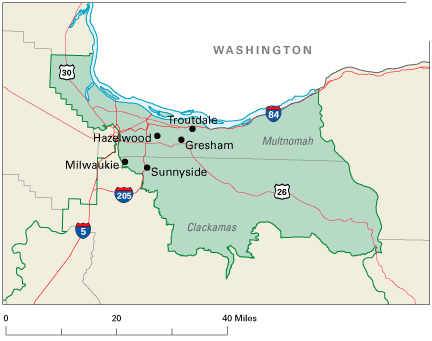
Being based on population makes area irrelevant, and the number of districts in each state are highly variable. Here in Oregon, there are 5 Congressional districts, based on population; the last Census showed a trend toward a 6th District, but we didn't quite make it. The population metric makes for some highly amusing borders. Prior to the reapportionment, this is what the 3rd looked like:


I live very near the dot marked Hazelwood. Fully three quarters of the city of Portland lived in the 3rd up to 2012, just the southwest part of town and part of the northwest being in the 1st District (currently Bonamici, formerly the ill-starred Wu). As of reapportionment last year, this is what the 3rd looks like:

Picture sourced from here.
The 3rd gained the west side of Portland and parts of Clackamas County, but lost the extreme NW panhandle of Multnomah County. Sauvie Island is now part of the 1st. At present, one Congressional district equals approximately 600,000 citizens. It has to be a more-or-less thing, of course; some Procrustean beds just can't be layed in.

The reason I told you all that was to tell you about this. You want to take a a crack at apportionment? Well, the congressional map is said and done and settled, but there is the city council of – appropriately – the Nation's capital, Washington, DC. The District is a unique animal as it has to be; politically independent of any state, the geographical size of a large city, with a population about that of a Congressional district, ruled essentially by the US Congress but with local control devolved to a twelve-member City Council which legislates for the community (the Congress still has the right to stick its nose in where it deems appropriate). Every so often the District has to do the same thing that the nation has to do, so this is kind of a microcosm.

You can take a stab at redistrcting the District, via the DC Redistricting Game, on the web at http://redistricting.greatergreaterwashington.org/, (via the regional blog site Greater Greater Washington). Following the game link above, you are taken to this screen:


This is the territory of the District of Columbia, divided into census tracts. The button on the right allows you to go into the main game if you don't live in the District or you do, but don't want The Man to know where you're spinning your nefarious plans from. Click that button, and you go here:


Now, we're down to business. These are Washington's 8 wards, which you might otherwise think of as Congressional districts in a State, only these have only about 70-80,000 citizens each. On the right there is a color coded list of Wards, populations, and whether the ward is too small, too large, or just right.

Game play from here on out is rather simple. Clicking on each census tract will display a small window giving you the population of that tract and buttons for each ward that you can assign that tract to. Naturally, you can't transfer a tract from deep within a ward to another ward; wards are contiguous, and  outliers such as enclaves or exclaves are not allowed … no gerrymandering now! The population list live-updates as you callously toss populations back and fort, and when everything's acceptable, you'll know right away. Then, you click the done button to share and boast of your Solomanic apportioning wisdom. This is what I came up with:


In order to balance things out, I took a piece of Ward 2 (green) and give it to Ward 1 (Orange); a piece of Ward 6 (pale blue), just west of the Capitol and containing mostly a bit of freeway, to Ward 2, balancing out those two districts. Wards 7 and 8, on the east point there, required a bit more finesse. I
have three pieces of Ward 5 (the dusky pink section along the NE edge (or consult that little map I have right because I'm still sucky at giving suggestive names to colors (when The Wife™ comes along and reads this, she'll proofread me, I'm hoping, because she's awesome at that)) to Ward 7 (buff, at the extreme eastern point). This overpopulated Ward 7, however, giving Ward 8 two small pieces of Ward 7 solved this problem. With those two adjustments, my map was in balance, God was in his Heaven, and civic peace reigns in the District.

Here's a link to my map which will give a better view (the swapped tracts are in a heavy outline:

http://redistricting.greatergreaterwashington.org/#25091-9mi6vq6n.

So, give it a try yourself. No smoke filled rooms now (computers hate that), or Machine politics (at least as far as I can tell, but maybe you can role play with some members of your family you don't like so much and threaten to pull funding on something or other (which DC Home Rule doesn't allow, but this is your game so, hey, play it up.

Remember, the URL is http://redistricting.greatergreaterwashington.org

20 May 2012

[map] 1,012 Years Of European Boundary Changes In 2 Minutes and 33 Seconds

2824.When I was a kid I got the standard, substandard American training in world history, meaning that, here in Oregon, it was all Oregon Trail (this was pre "you died of dysentery") with the occasional dash of Lewis & Clark, numerous attempts to correctly pronounce "Champoeg", and periodic field trips to the Oregon Capitol Building (which provided me with a love of architecture but not much of history). As far as American, US, and world history, I'm pretty much an autodidact.

When I started reading The Rise and Fall of the Third Reich, I was still not completely clear on the fact that international boundaries are not permanent verities, although the 1990s really started to change that, at least insofar as the Germanies could reunite. Reading the history of Nazi Germany, with its de facto boundary changes due to out-and-out annexations (Austria, the reattachment of east Prussia, and such) was a real lesson for me.

Someone, somwhere, somehow, has done a huge service, though, by taking all the European boundary changes from the year 1000 CE to the present day and animating them. It's a flawed production: there should have been an animated timeline, and the colors that change are not defined. But to watch the boundaries fluctuate over time is quite compelling. If you're familiar with such things as the Holy Roman Empire (which was only Holy and Roman in that it was beholden to Rome; it was actually a German empire), the Ottoman Empire, the growth and decay of Lithuania and the numerous divisions of Poland, you'll have some idea of what's going on and when.

I was also surprised, by the by, when I found that, for a time, Rome belonged to the French. Like I said, I got the standard American education in history.

All that being said, the video.

18 May 2012

[OR_liff] 30 Minutes on Mass Transit in Oregon

2823.This also speaks to mapping and information design, as well as being just darned interesting.

Before I quit the computer for the day, my wandering eye happened on this article at The Atlantic, titled "30 Minutes on Mass Transit in 20 World Cities": http://www.theatlanticcities.com/commute/2012/05/30-minutes-transit-20-world-cities/2033/. It is what it says it is, but it gives you a concrete idea by diagramming it against maps of those 20 world cities.

Alas … this is one list Portland did not make. Didn't anyone tell them we were hip?

The maps in The Atlantic's article were generated using an interactive tool called "Mapnificent". Mapnificent allows you to zoom in on any city featured and, via a simple graphic slider, choose your time span. Three Oregon transit systems opened their secrets to Mapnificient, and they are, of course, Portland (TriMet), Salem (Cherriots) and Eugene (LTD). Here is Mapnificent's idea of how far you can get in Portland in 30 minutes on TriMet, starting from Pioneer Square:


Here's Eugene, on LTD, point of departure being Eugene Station (the block between 10th and 11th Avenues and Willamette and Olive Streets):


And Salem on Cherriots, departing from the Courthouse Square block, between Chemeketa, High, Court, and Church Streets NE (Mon-Fri only … Salem you are awesome!):


The intriguing part is the discontinuities on the smaller cities' diagrams. One can only assume that schedule information is a little incomplete, or the data set is elided due to some sort of express route or lack of stops along certain streets in certain areas.

The tool is located at http://www.mapnificent.net/. You can watch a short instructional video or just zoom in to the city of your choice, click on the marker, and use the slider to your hearts content. The interface is rather self-explanatory.

05 September 2011

[map_design] Cameron Booth Gets Portland's Rail Map To Grow Up

2685.While i like the TriMet rail system map and have grown to like the new TriMet empire style, it has not been lost on me that, just as the old style (which I still miss) was destined to give way eventually, this style will too, eventually, give way to another look. And I've seen the direction it ought to go.

Cameron Booth likes designing maps, and he's come up with a brilliant take on the combined Portland area rail display that makes the current look rather … well, provincial. A bit of it is at right for illustration's purposes, and the rest of his work is at his blog here. Go there, because that's where all the closeups are.

The thing I enjoy the most of it is that this map feels like it could stand, style-wise, next to the great transit maps of the world - the NYC subway, the London Underground. By eschewing the ever-present 45-degree angle, using instead 60- and 30-degree angles, he's hit upon something the other map doesn't have … a high degree of congruence with the way the Portland street and ground grid actually looks, so it's easy to picture where you might actually be in relation to the reality, but it allows it to be schematic enough to clearly show the system in a usable way.

The choice of type face is quietly sophisticated, and the choice of using a dark background brings a sort of drama to it and lets the network stand out from the supporting background. Nice touch.

The real innovation about the map is that it shows all passenger rail services here in Portland - unlike the TriMet Rail System map, which reduces the Portland Streetcar line to an unannotated line that kind of fades into the background. Showing the Amtrak lines gives a sense of a link into the greater world. To top it off, it includes proposed or under-construction lines and stops extending to Vancouver and Milwaukie.

The whole effect is very big-boy, very sophisticated, information-rich without being cluttered … very grown-up. And very well-done.

09 December 2010

[map design] When Map Designers Bicker

2547.
In the past, I've commented a little on the evolution of the design of TriMet's maps, particularly those of the MAX system as it becomes more complex over time. Rail network maps are a product, just like many other things, of their environment, particularly visual styles and fashion; my take is that most systems try to follow the lead set by the justly-famous London Tube Map, which has become iconic of its own system.

New Yorkers are, in their way, like us here in Portland; they like things the way they like them, and tampering with something considered by them iconic can be as disastrous as New Coke was. This probably also extends to the Subway map - a map of something uniquely New York.

The website Gothamist reported very recently on a panel held by the City Museum of New York where designers who've developed the subway map over the years held forth on what they thought was good and bad. They were, in fun way, most opinionated.
The panel of speakers included Massimo Vignelli, the revered designer of the 1972 subway map; cartographer John Tauranac; Paul Shaw (of the Helvetica documentary); and Eddie Jabour, inventor of KickMap and its iPhone app. The four men traded barbs, and went into detail about their own relationships with subway maps; Vignelli talked about the criticisms of his '72 map design, and noted he never perceived the map as a navigational tool. He also made an impassioned plea for sleek, modernist maps like there are in Europe, which Capital New York said
was "a League of Nations-like response in a WikiLeaks era."
The '72 map design referred to above can be seen here, courtesy of the blog IdeaOrange. It completely abandons the geographically-oriented subway route display in favor of the utterly-schematic, almost electronic-diagram modernist style pioneered by the London Underground and similarly-styled maps, and works very well indeed. Of the current style, a member of the panel savaged the style of having "bilious" colors and the lack of a service guide.

I guess there's just no pleasing some people.

But the subway is part of the identity of NYC, and no matter what you do, there's someone who's going to point and say "her? Oh, she's had work done, you know"

Myself, I'm a fan of the way Vignelli did things. After all, it is in the Museum of Modern Art.

H/T Atul 666, on the web at http://cyclotram.blogspot.com, twitter @brx0

Technorati Tags: , , ,

Powered by ScribeFire.

08 July 2010

[design] PDX Iconized To The MAX: The MAX Vertical System Map

2469.
Here's something we missed ... and something that really took me delightfully by surprise.

First thing I want to note before I go there is that the all transit and rail maps eventually want to grow up to be the Tube Map. It's the serendipitous acme of transit map design. The "Tube" I refer to, is, of course, the London Underground, and its map, originally designed by Harry Beck in 1931, has achieved the status of icon, influencing the design of many systems since - it seems that almost every major European city rail system diagram echoes it.

Even though you probably had a version of it spring forth in your mind, unbidden, you can refresh your memory by checking out the Wikipedia version of its history at http://en.wikipedia.org/wiki/Tube_map.  It's correct enough. The premise is that, since you're travelling underground, simplification is the ideal goal - you can't orient yourself by landmarks when you can't see the land, and, if you're smart, you've entered the Underground knowing where you are, knowing where you're going, and having some idea of the line you're taking to get there. So, colored lines distinguish the rail lines, and simple dots and circles, evenly spaced, simply connected if they simply connect.

The result is orthographic, straight-line genius, and even though the basic graphic look has changed a little as the system has, the overall look of the map is more-or-less the same. You can see the kernel of the 1931 map in the slickness of the 2010 edition. The circuit-board-like design is, quite simply, timeless.

With the expansion of TriMet's MAX rail service map, which began geographically correct when the original downtown Portland-to-Gresham service took off in 1986, has increased in schematic aspect as the lines grew and the complexity increased. The current horizontal display, now viewable at TriMet's site as well as at MAX stations, does a magnificent job but retains just a little of that geographic familiarity. But the older trains (according to a quote in a Joseph Rose column that I missed back in February) don't have spaces that support a horizontal format as well. So, presumably, why don't we not only reorient the map but throw a little Europeanish redesign in it was well? We first saw this last evening, and since I missed the February column, I didn't know about it till then - and was most pleasantly surprised. This is PDX iconized.

Actually I don't know if they thought it was European. I will go so far as to say that I bet they know they thought it was smart. And I agree. Because, really, when you're riding on the MAX, what do you really need to know about where you're going? If you're smart, you have some idea of where you're going once you get off the train, and have a clear idea of where you got on and what line of TriMet's plethora of five glorious rail lines you'll need to use.

So, make sure you're on the right line, and count the stations. That's all you really need to do.

What I particularly find delightful is the little double-stripe connecting the Rose Quarter TC and the Interstate/Rose Quarter Yellow line stop. That the heart of the system - Pioneer Square - is represented by a big circle befits its iconic status in Portland geography. The bifurcated nature of the lines in downtown are simplified by combining the stations into one icon and merging the names with a slash.

And it, like great transit maps of its ilk, shows the loving influence of the great Beck design, the most iconic of all transit maps - the Tube Map - and we know this, because it works the same way.

We dig it.

Go see Joseph Rose's commuting column to see the map embiggened:
Technorati Tags: , , , , ,

Powered by ScribeFire.

10 June 2010

[map design] A Nation Where Boring, Oregon Stands Tall

2433.
Latterly having caught our eye, a map of the USA which includes towns like Boring ... and only towns like Boring:


© 1987 D.Jouris/Hold the Mustard. All rights reserved.
The copyrighted image may not be reproduced, altered, or transmitted in any format
Clicky on the map to embiggen.


Boring stands tall in the Pacific Northwest, but an Oregon labeled "Boring, Remote, Needy" sounds more like an advertisement than a gripe. As a native Oregonian, I can tell you this.


Hold The Mustard
sells many such cards and most are quite teh funnay.

Thank you to David Jouris for the permission to post.

Technorati Tags: , , , , , ,

Powered by ScribeFire.

22 May 2010

[design] The Hipster NYC Subway Map, with Connections to Prague and PDX

2418.From Twitterer @FakeMTA, via Dave Knows PDX (@daveknowspdx) we give you the Hipster-friendly NYC Subway map (clicky on the piccy to embiggen)


On the upper right, you have connections to Prague, and the left branch takes you straight to glorious PDX (distance: 2,897 miles). Lines end in locations like "Talk about going here", "You Passed Out Again", and "Mom's House".

Teh funnay? You bet.

Technorati Tags: , , , , , , ,

Powered by ScribeFire.

16 December 2009

[maps] The Bus-Train Map Design Connection

2277.The various designs of city transit railmaps that can be found in the USA and globally are beguiling works of abstract art, the designs of which seem driven in the main by the famous design of the London Underground, with its simplified and straightened ways and absolute horizontal, vertical, and diagonal lines.

Simplification is good, and it renders a map which can be used. But not always does it render a map that communicates reality. The most useful versions of these connect the abstraction of the rail routes to the reality of the bus network it is supposed to work with. But, as Michael Perkins of Greater Greater Washington correctly laments, this is not always the case:

Out where those spur lines diverge, it's often faster to take a bus between the lines rather than ride into downtown and out again. It's more efficient for the network too, since those trips route people through the congested core unnecessarily. Boston's highlights the major crosstown routes and routes reaching important destinations not served by the rail system.

Could Metro do something similar?

His post (http://greatergreaterwashington.org/post.cgi?id=4289) points out the example of Boston's MTA rail map, which actually shows key transit routes that will get you between rail lines, and does it clearly:


The style of the lines is very well done too.

He gives Portland credit for doing the same sort of thing, though the execution is somewhat different – just the route numbers, not the routes themselves, though the omission of actual routes preserves the communicative clarity given the graphic approach:


The small numbers ranged along the stations tell you exactly which other schedules you should be referring to. The crossings are not given for the city center area in the main; that presumably, with the welter of lines coming together in those areas, is a bit impractical. But in the outer areas it's immensely useful, and helps you get an idea of which route you're going to need before you get there.

It's a simple thing, but a good thing.

Technorati Tags: , , , , ,