
2047.A ways back, I found and posted a link to a video of Scott Adams doing a Dilbert daily strip.
It's very hard to find interesting videos or pictures of artists actually creating thier art, so it's been awhile but I just turned up another one.
I don't speak of it often (I'm not ashamed or anything, it just doesn't come up), but I have long been head-over-heels in love with Tintin, the boy reporter. I wish I could say I've been reading him since I was in grade school, but that isn't true; I discovered him as a young adult. But when I opened my first Tintin album, I was immediately smitten.
There are a lot of interesting things about him. Even though he's a boy reporter, in the traditional globetrotting adveturer style, I only recall him filing a story ever just one time (near the beginning of the adventure The Shooting Star). He wore his trademark "plus fours" (those short, bloused pants), traditional uniform of the European child of the day, until his last published adventure in the 1970s (Tintin and the Picaros). The 80s new-wave musical group Thompson Twins took their name from the two comical, bumbling, bowler-hatted opratives Thompson and Thomson (they even had an early song "We Are Detective").
His creator, the Belgian artist Georges Remi (known by the Francophone pronounciation of his initials reversed, or Hergé), is credited with being the originator – or at the least, the perfector – of the comic style known as ligne claire, or "clear line". It's a visually exciting collision of fancy and reality, in which all lines are drawn as clear, strong, equally-important-weight lines. It's a beautiful style.
 Anyway, I told you all that as introduction to this very short clip I just located on YouTube, in which Hergé dashes out a signature Tinitin-and-Snowy sketch to (apparently) a fan with a pen in just a handful of quick strokes (follow the link there ... I tried embedding the video but my version of Firefox just shows a big white box).
One of the most amazing things about a practiced artist, as Hergé certainly was by this time, was that drawing the figures was so natural after years of doing it that they emerge from the pen of the artist almost as though they were extensions of his physical form that just grew from the pen itself.
I recently stumbled on a copy of a rerelease of the last unfinished Tintin, Tintin and Alph-Art, which Hergé was working on before he died. It remains in the form of a transcription and his layout pages in the process of being set up. Amazing stuff. I'll share that in another missive.
Technorati Tags: art, artists, Herge, Tintin, artists at work, art tools, art techniques, drawing, cartooning, clear line, European comics
It's very hard to find interesting videos or pictures of artists actually creating thier art, so it's been awhile but I just turned up another one.
I don't speak of it often (I'm not ashamed or anything, it just doesn't come up), but I have long been head-over-heels in love with Tintin, the boy reporter. I wish I could say I've been reading him since I was in grade school, but that isn't true; I discovered him as a young adult. But when I opened my first Tintin album, I was immediately smitten.
There are a lot of interesting things about him. Even though he's a boy reporter, in the traditional globetrotting adveturer style, I only recall him filing a story ever just one time (near the beginning of the adventure The Shooting Star). He wore his trademark "plus fours" (those short, bloused pants), traditional uniform of the European child of the day, until his last published adventure in the 1970s (Tintin and the Picaros). The 80s new-wave musical group Thompson Twins took their name from the two comical, bumbling, bowler-hatted opratives Thompson and Thomson (they even had an early song "We Are Detective").
His creator, the Belgian artist Georges Remi (known by the Francophone pronounciation of his initials reversed, or Hergé), is credited with being the originator – or at the least, the perfector – of the comic style known as ligne claire, or "clear line". It's a visually exciting collision of fancy and reality, in which all lines are drawn as clear, strong, equally-important-weight lines. It's a beautiful style.
Anyway, I told you all that as introduction to this very short clip I just located on YouTube, in which Hergé dashes out a signature Tinitin-and-Snowy sketch to (apparently) a fan with a pen in just a handful of quick strokes (follow the link there ... I tried embedding the video but my version of Firefox just shows a big white box).One of the most amazing things about a practiced artist, as Hergé certainly was by this time, was that drawing the figures was so natural after years of doing it that they emerge from the pen of the artist almost as though they were extensions of his physical form that just grew from the pen itself.
I recently stumbled on a copy of a rerelease of the last unfinished Tintin, Tintin and Alph-Art, which Hergé was working on before he died. It remains in the form of a transcription and his layout pages in the process of being set up. Amazing stuff. I'll share that in another missive.
Technorati Tags: art, artists, Herge, Tintin, artists at work, art tools, art techniques, drawing, cartooning, clear line, European comics


 The Red Fish sector covered NW and N Portland, from approximately the crest of Forest Park east to a line more or less alone Martin Luther King Jr. Blvd/Union Avenue. Locations in this area included Saint Johns, the Portsmouth area and the North Portland Peninsula, the trendy Northwest district, the and the Northwest industrial district.
 The Purple Raindrop (no, not "Purple Rain", no joy for Prince fans here) covered an arc from approximately Martin Luther King Jr Blvd to a line more or less parallel to and a little south of Northeast Sandy Blvd. Destinations in this area included Portland International Airport, Parkrose, Hollywood, Woodlawn, the golf courses along Columbia Boulevard, Rocky Butte, and classier Northeast areas such as Irvington and Alameda.
 The Blue Snowflake had at its northern boundary that aforementioned line south of Sandy and swept down to a line more or less between Burnside and Southeast Stark Street. East of what would eventually be I-205, the area covered everything from Burnside/Stark up to the Columbia River, all the way out to Gresham. With the advent of MAX service and the establishment of a full-service Transit Center at Gateway, all Blue Snowflake routes terminated there and were removed from thier Mall stops, those stops becoming local service/Union Station service.
 The Brown Beaver sector served in the main the working-class SE part of Portland, specifically that part south of the Burnside/Stark corridor and east of the Sellwood/Moreland area, extending also all the way out to Gresham; essentially any route that was going to SE but wasn't eventually bound for Milwaukie and points south.
 Like the Red Fish, The Green Leaf sector covered an area on both sides of the Willamette River, serving Johns Landing, Sellwood, the eastern 2/3rds of Lake Oswego, Milwaukie, the suburban corridor along McLoughlin Blvd including Jennings Lodge, Oak Grove, River Road and such, and also such SW desinations as Tualatin and Wilsonville. If you wanted to go to Marylhurst College or Canby, you boarded a Green Leaf route.
 The Yellow Rose took in the neighborhoods of inner and outer SW Portland, such as Hillsdale, Multnomah Village, Garden Home, the Vermont Street area, the Washington Square Mall, PCC Sylvania and Lewis and Clark College, and outlying communities like King City, Tigard, and Sherwood. It also served suburban SW areas that lay, generally speaking, south of Scholls Ferry Road.
 To complete the circle, the Orange Deer sector took in everything from about Scholls Ferry Road north to the Tualatin Mountains (Forest Park). Everything along the TV Hwy/Canyon Road corridor and the Sunset Hwy was in this district. This took in Beaverton, Cedar Hills, Cedar Mill, the Cornell Road corridor, Bethany, Tanasbourne, Aloha, Hillsboro, and Forest Grove. If you were bussing it to the Zoo or OMSI (when it was up on the hill), you took the 63-Washington Park, from the Orange Deer shelters.


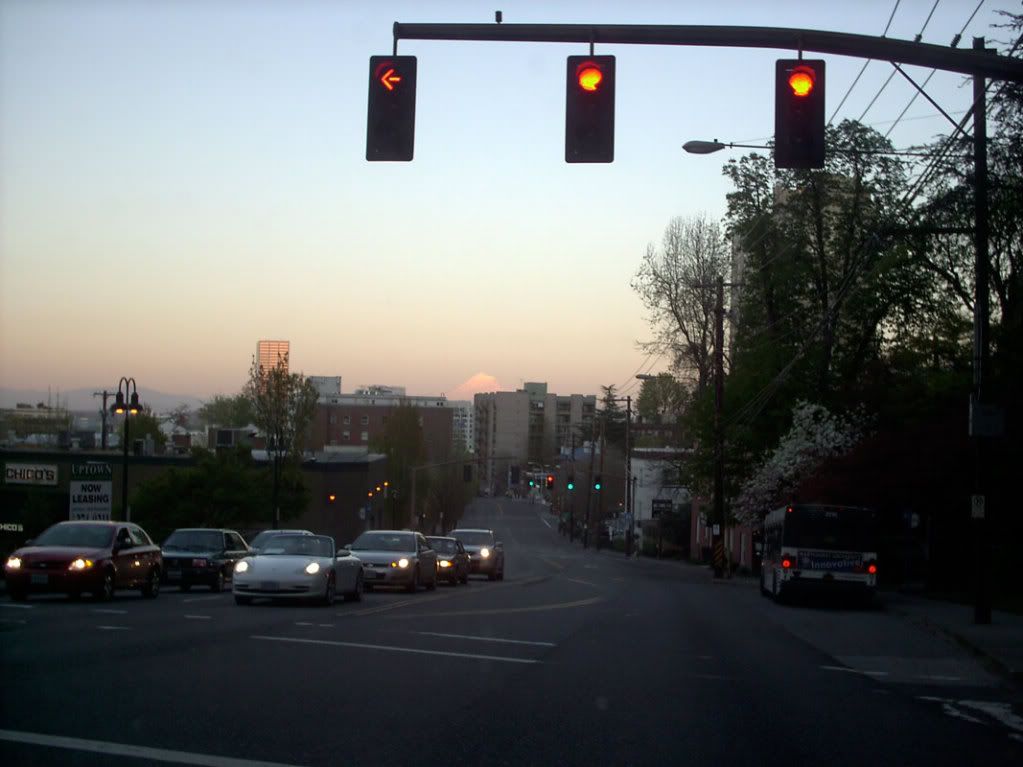
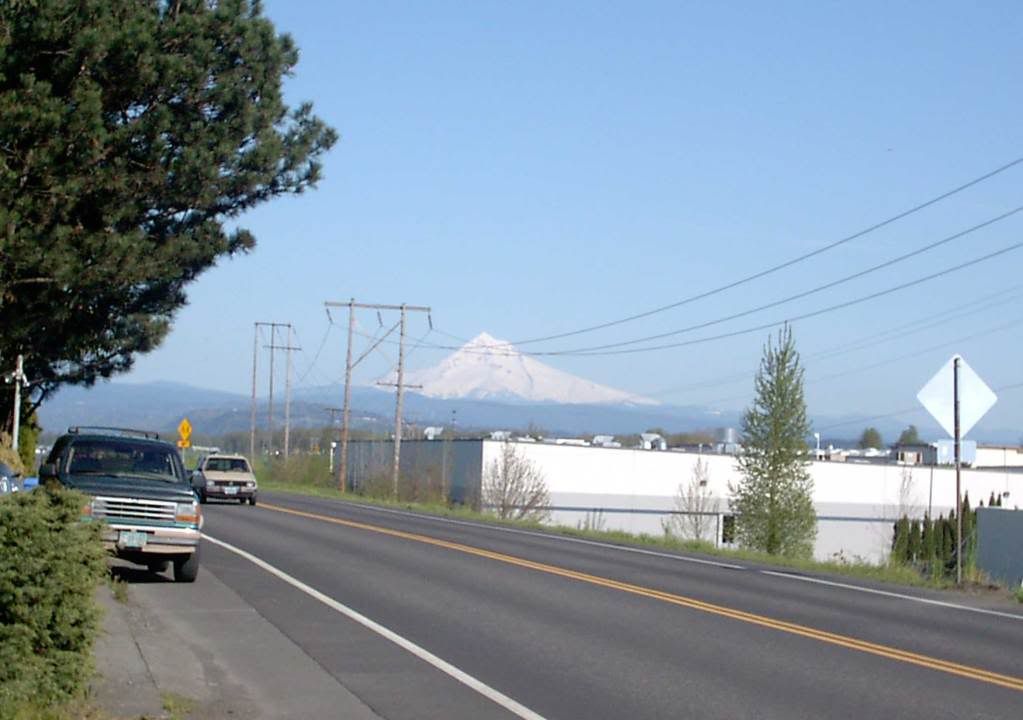

 Out on new street-blade patrol today, inspired by a tip from


 Now, for some logo talk.
 Acrylics are amazing, actually. They can be thin like watercolors, or thick like oils. They lend themselves to a great many styles and modes of painting.

 Of course, this wasn't meant as much of analogy: the power players and the people who consider themselves "stakeholders" in the discussion have much different attitudes and connections. But it would do everyone well in such discussions of changing the visual character of city skylines to remember that, whether or not they want to admit it, the public will claim a certain "ownership" to something that forms the backdrop of their very lives.